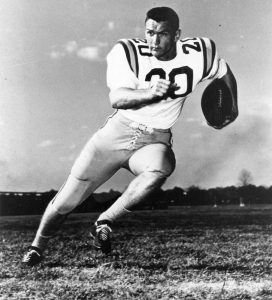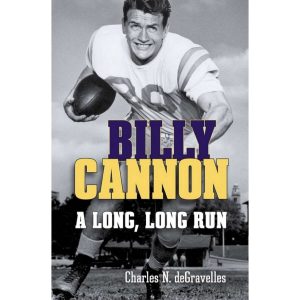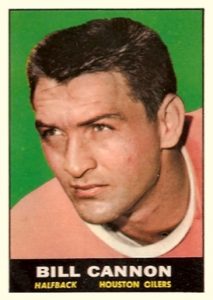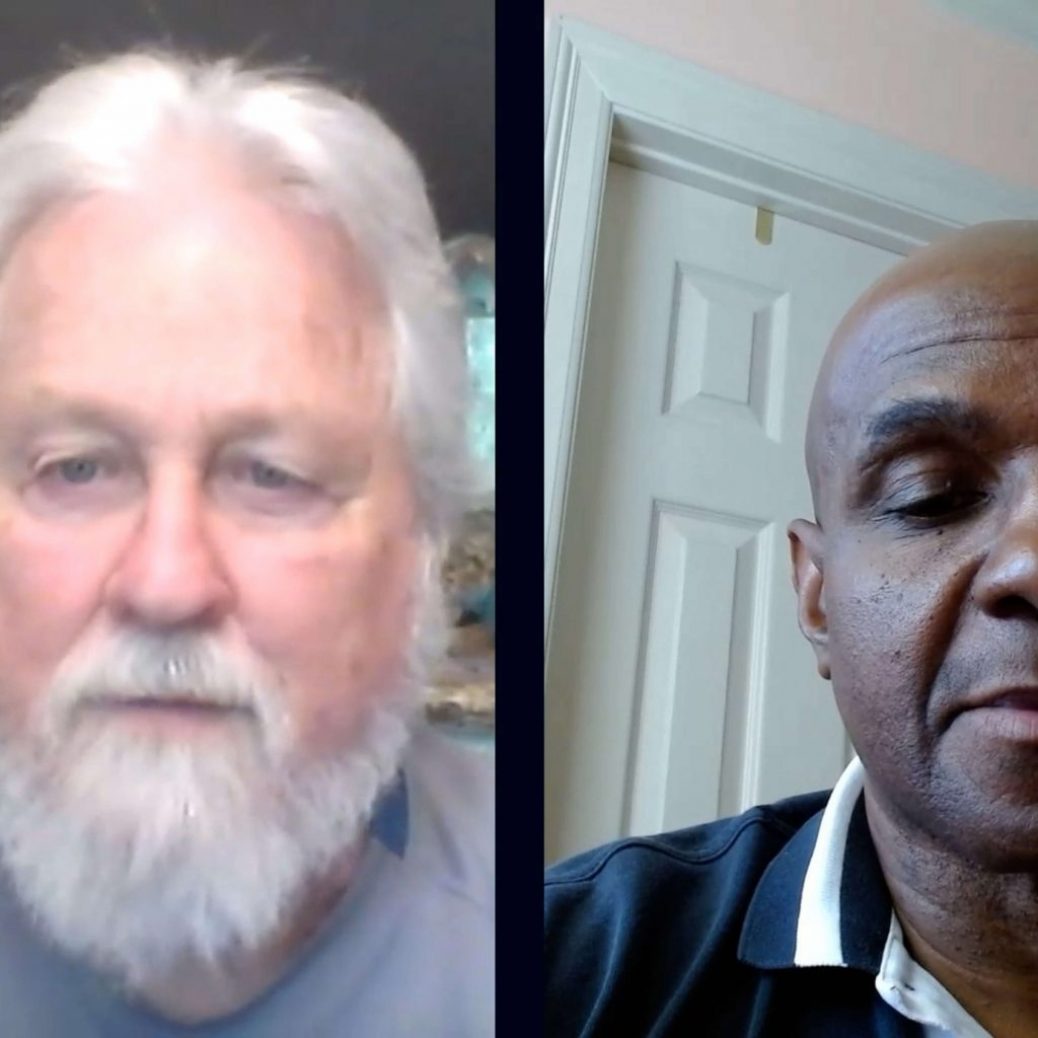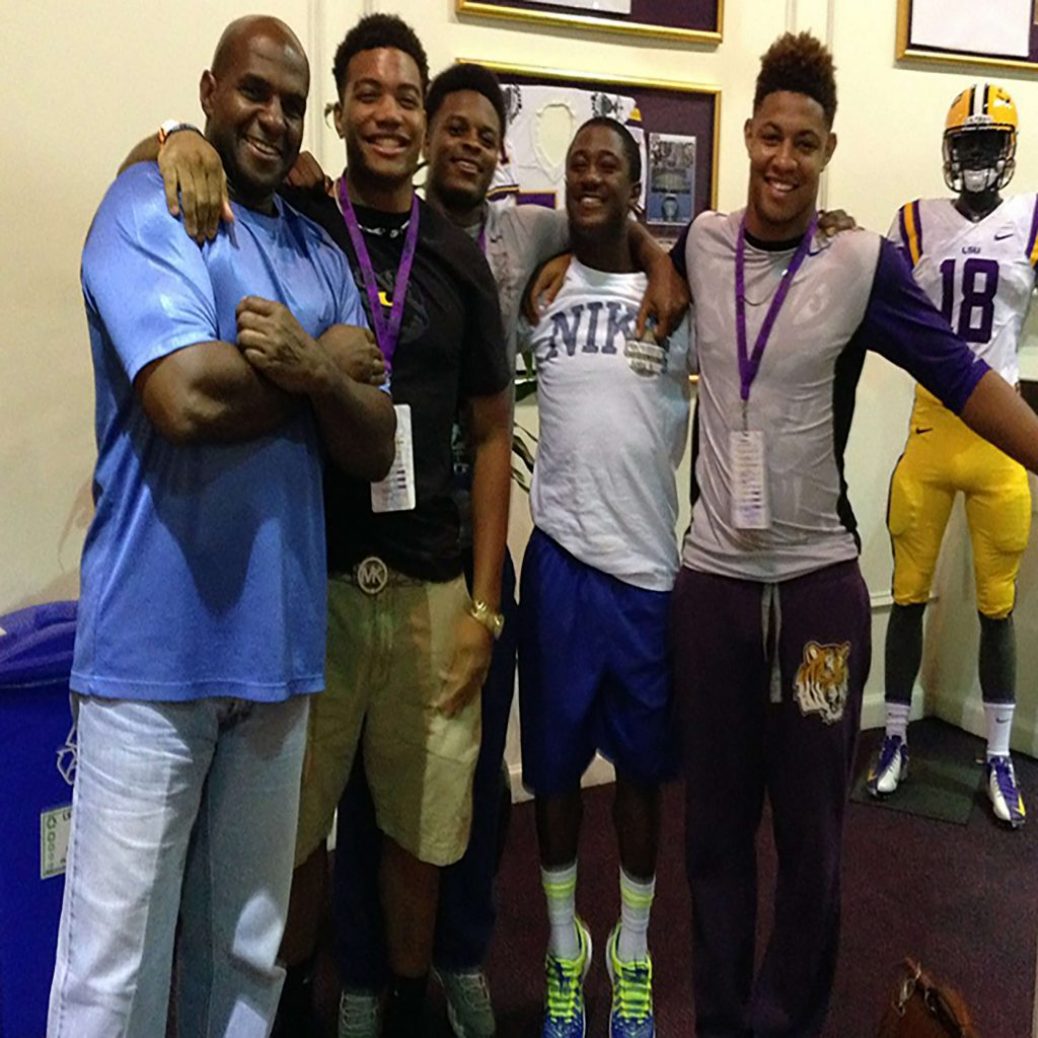

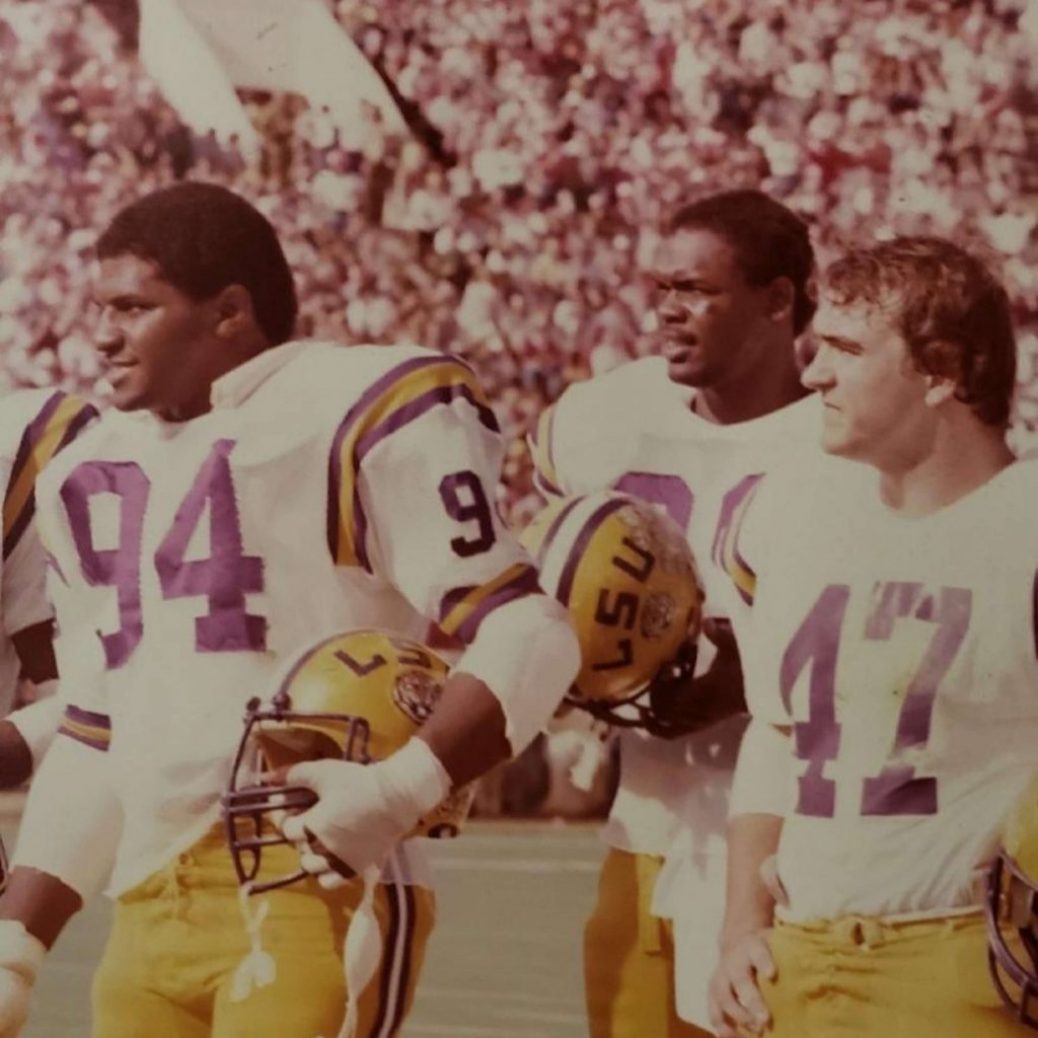
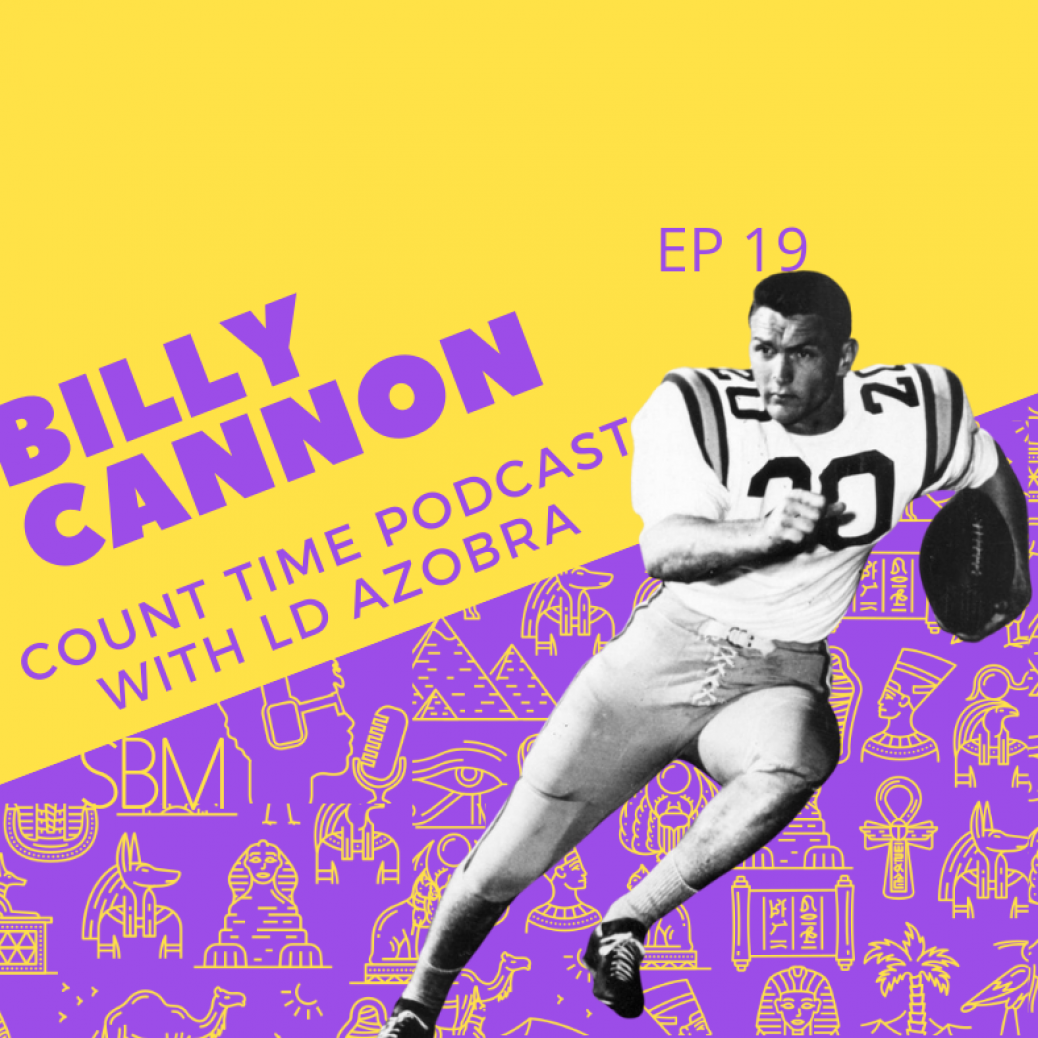
LD interviews LSU football Living Legend Greg Lafleur. They discuss their time together at LSU and the different paths they took to the NFL. Listen in for never heard before LSU football history and great, inspiring life stories. Greg also reviews Billy Cannon A Long Long Run.
Please leave your comments below. If you haven’t yet subscribe to the Count Time weekly alerts. Let us know what you think of the show and suggest topics for future episodes.
WHAT IS COUNT TIME?
Count Time Podcast features LD Azobra formerly Lyman White, formerly of the LSU Tigers and the Atlanta Falcons. Join LD as he describes a journey to enlightenment, awakening and truth. Count Time it is time to Stand Up and be Counted.
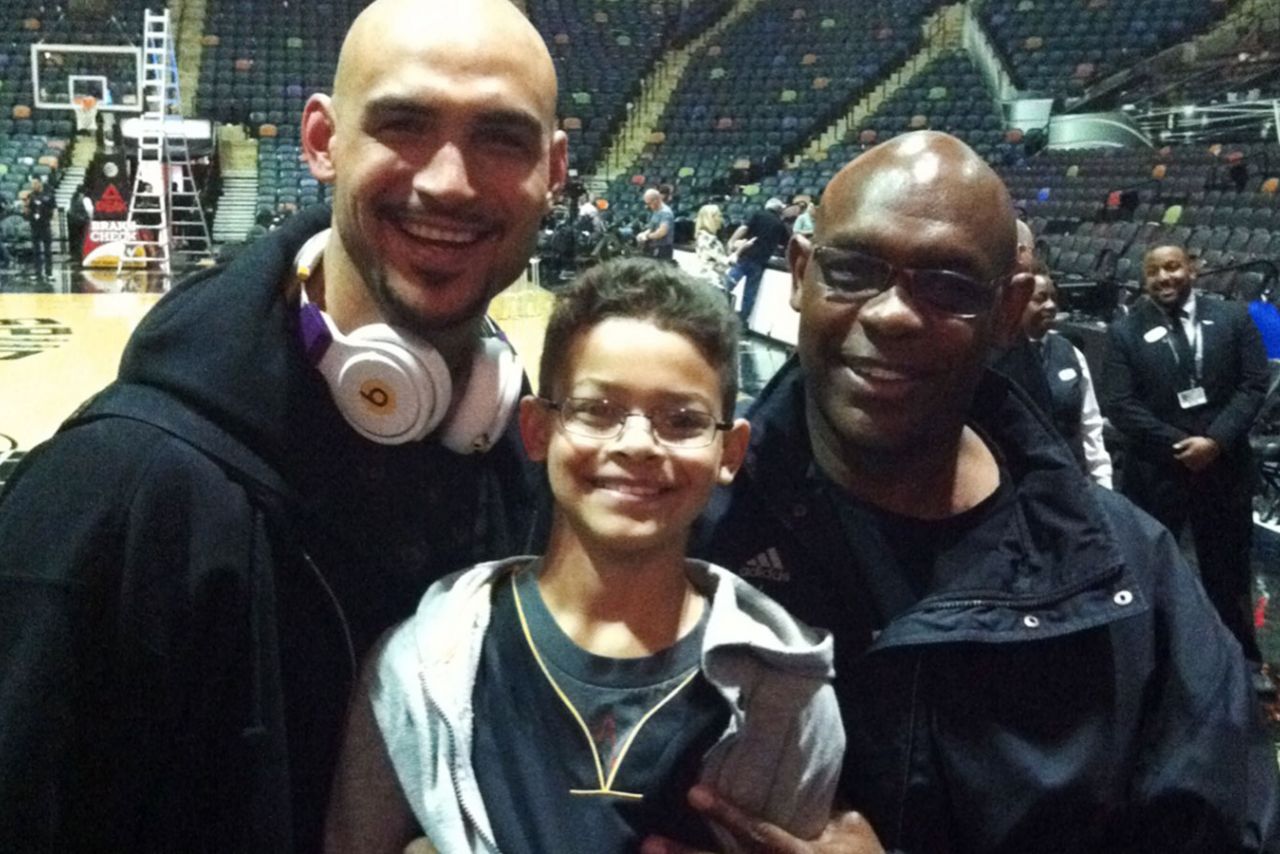
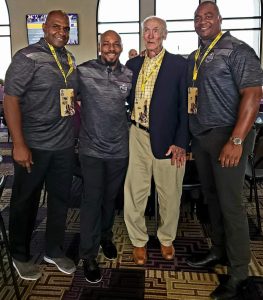
Greg with sons Robert Sacre and Greyson
Selected quotes and notes from Count Time Podcast with LD Azobra Interview of Living Legend Greg Lafleur
Good evening. Good evening. Good evening is 4:00 PM. Stand up. It’s count time, time for every man and woman to stand up and be counted. Welcome to another edition of count time podcast. I am brother LD Azobra formerly named Lyman white. Thank you for joining us today.
LD:
Welcome everyone to Count Time. Another edition of Count Time. We have a young man visiting with us again today. Dear friend, a teammate, we go back a long ways. You’ve been on the show before and it would be glad to have him back. We got here the great, awesome tight end LSU and St. Louis Cardinals, the Mr. Greg Lafluer.
Greg:
Thanks again, LD for having me on the show.
LD:
You know, it’s a pleasure, my friend, uh, a partner, we go back a long ways over 40 years thought We would be saying that one day?
Greg:
No, no, not forty years. And matter of fact, it’s almost forty-five years.
LD:
Man, man Where have time gone. Right. But let everyone know. He’s still looking great in great health, physically, spiritually, mentally, you look great. You look wonderful. Thank you for coming back today. Cause last time we had a more intellectual discussion, I guess, right? We discussed the book by Charles deGravelles something like that on Billy Cannon, a long, long run. And we had a discussion about that book and it went well. And I appreciate you coming in for that purpose. Cause you sent me the book to read and I decided that we would have discussion about it, but we didn’t get a chance to have a discussion about your time nor my time at LSU together. So this was this, uh, conversation going to be about. We’re going to have a discussion about your experience at LSU and uh, beyond in our experience together, you got there, you arrived to LSU a year before I got it. Let’s see. Tell me, how you end up at LSU.
Greg:
I got to LSU in 1976, as you know, I grew up in Ville, Platte, Louisiana.
LD:
Oh, let me send a shout out to my dear friend and mayor of Ville Platte Mayor, Jennifer vitrine. I can’t leave you out . Right? She was in school with us at LSU. She was
Greg:
So, you know, not, uh, LD growing up in the sixties, uh, LSU was not an option, so I never even considered going to LSU because it was not possible. And then my freshman year in high school, LSU had its first black player, Mike Williams and LoRa Hinton. But it didn’t phase me that much. Cause it was just two of them and only one really played. That was my William because Laura Hinton I think
Greg:
Had some injury problems. Yeah.
Greg:
So the only person we saw on TV was Mike Williams.
LD:
He was an awesome defensive bank. Right.
Greg:
So I didn’t have any interest in going to LSU.
LD:
Nor did I. None, zero, zero
Greg:
With me too. Because when I was growing up and if you saw a black person with an LSU shirt on, you knew that mothers worked at some white folks home and that was some hand-me-down clothes. So that that’s all that LSU meant to me. So it just didn’t because it was not an option. It’s not like I didn’t like LSU. It was just not an option. My junior year in high school, we were at spring practice and this white fella came out on the field and he was standing there watching practice. And my head coach came up to me and he said, Hey, you see that guy standing on the track? I said, yeah. He said, that’s the coach from LSU. And he’s here to watch you practice. What, what position you played? And I was a quarterback in high school and the coach was coach McCarthy, the offensive line coach.
Greg:
And he was there watching me practice. I still had no interest in going to LSU. So I go into my senior year in high school and now it’s time to take our visits, you know, and I get the LSU on my official visit. I just took the visit because they offered me to come and take a visit at LSU. I’m not gonna turn down a free trip to Baton Rouge to go watch LSU play Alabama. So I came to the game and I was just shocked when I walked into that stadium. And at the time the stadium on the hill, 65,000 people, they didn’t have the upper deck
LD:
Only 65,000
Greg:
At that time. And I was just in awe of the, of the crowd and what threw me off and Lyman coming from Ville Platte. When we walked back into the locker room, after the game, everybody kept their jerseys. I’m like, what? Y’all get to keep your jerseys. Could you already had those tearaway jurors at that time, y’all get to keep your journeys. And so all that stuff was happening around and I’m like, wow. So then I went home and told folks what I experienced at LSU. And that’s when I started to get interest on attending LSU after my official visit. But before my official visit, it was not on my radar at all. You also played basketball
LD:
Yes. In high school. And you had another visit from LSU.
Greg:
Well, my first letter that I received, my first college letter I received was from Dale Brown,
LD:
The Great Dale Brown. LSU coach. And I
Greg:
Still have that letter today, but I knew I was not a very good basketball player. I was tall and can jump and all, but my coach wouldn’t let me dribble the ball. And I knew six, four. Wasn’t tall enough to try to play college basketball without dribbling. So the coach brown kept hounding me. He kept saying, why don’t you come to LSU and play basketball? And even after I got to LSU, when I’d run into him on campus, he said, Hey, you could you’ll come out for the basketball team because I was not playing very much. And I’m sure we could talk about that a little bit once we get into. So
LD:
When you got to LSU, ya’ll was considered the largest class of African descent players. How many of y’all the had?
Greg:
Yeah, we had eight. It was only four on the team when we got there only for the team. And when I got that, it was eight of us. The ride in the Royal twin from baker high school. We’ll go stands, bear from, uh, McKinley high school. Uh,
LD:
And Wilbon is deceased in the roars deceased. Yes.
Greg:
And, uh, Sterling Sterling, Vizio
LD:
From an Edgard,
Greg:
Willie Teal from Texarkana, Texas. My roommate, Carlos Carson. You’ll have you spoke to Carlos a year ago. Okay. From time to time, we, we, we try to talk at
Greg:
Least once a year. I have not seen, I spoke with it doing very well
Greg:
In Kansas city. He owns a McDonald’s in Kansas city. So that’s seven. Yes seven. And then, uh,
LD:
Uh, 600 [inaudible] Sterling.
Greg:
Carlos Carson.
LD:
And you
LD:
It, did we mention when the Tio, oh, you know what? The other one, his name was hill. A guy named hill signed with LSU. When he didn’t show up, he went to Yale and played at Yale. His name was hill and I’m good friends with his brother, Ernest hill, who was an author. You sent me a book called satisfied, but nothing is here years ago, years ago when his brother signed with us, but never showed up and went to Yale.
LD:
That is interesting. You sit near a book years later, that was 27 years ago.
LD:
Aloma books.
LD:
I that one of the best books I enjoyed
Greg:
Ernest hill wrote that book. Well, his brother hill went to Yale, got drafted in the second round with the New York giants and played about 10 years with the giants. So he didn’t show up. They were from Oak Grove, Louisiana. Right,
LD:
Right. Ernest Hill. I haven’t heard that name in a year, wrote a book, title, satisfied with nothing. And he wrote several other books after that. I don’t remember the name of that book was very, I would encourage someone to look to pick up the book and read it because it’s a very good book. Uh, it is. It takes you to a journey in, in, in, in end up in a place you didn’t think he was gonna end up as a, I thought it was a very, very good book. So in your class you had six, seven of you. All my class came the next year had eight of us eco include me, Marcus queen, uh, will it Turner with disease to meet William? My roommate whose disease? They, the swallow was deceased. Chris Williams. Who else? I can’t remember now. Okay. Well, is that everybody that I’m still missing?
LD:
The three of Tracy Porter who Tracy roommate, Danny and trace was roommates, linear wireless wide receiver. And there’s one other guy we go take up. And it was, he was able to, we had the largest class of freshmen. So we had seven. We had a interest by one next year. They increased it by word and it brought a little bit different deport linebackers. You know why I received when I received two to Carson, Trey, but Tracy and Wallace was to learn. It was a wide receivers, but also the year I got to use you, they had, they didn’t know what to do with you. They had you played,
Greg:
I was a quarterback in high school and they were honest with it upfront when they were recruiting me. They’re like, you know, we’re going to make a tight end out of you. Cause I was six, four and I could run, you know? And they said, well, you know, we’ll put you in the weight room, have you get bigger? So we could move. You’re either tied in wide receiver and tight end or whatever. So when I got to LSU in 76 and you know that the freshmen didn’t play only two guys on our sign-in class played John Adams and Willie till they were the only two freshmen that played. So the rest of us, we didn’t even, you know, you have to practice everyday and you lost that year of eligibility, but we had freshmen games. So I didn’t get to play as a freshman. Then I come back my sophomore year and you hit you at LSU at that time.
Greg:
Right? And you remember this, but you probably wouldn’t pay any attention to me because you want defense. And most people that that’s not familiar with football, don’t realize it’s almost like two teams. You guys rode a different bus. Your roommates would all defense. Our meetings were always separated. The only time we came together was when the head coach spoke to the whole team. Other than that, we were never together right at my rest, right? So we went to Indiana and played Indiana the first game of the season and Carlos and I alternated every other play. So neither one of those nailed down the starting position. Your sophomore year, my sophomore year, then we came back to Baton Rouge for the second game, rice rice we’ll call. Those, went into the game first and they threw them a pass and he went 80 yards for a touchdown. So the next time we get the ball, they call a run in play. And then I have to run out the game. Carlos ran in the game and they called another pass play. He went to 65 yards, but touchdown. So the next time we get the ball, I go in and they caught a run in place. Then I run out, call those runs in and they call the past plate
Greg:
And it threw them a fan. There was another touchdown. Three consecutive. Now the next time we got the ball, they put me in Colin’s goals in the game. They called another pass. Touchdown. Next time we get the ball, Carlos, go. Then they call another pass plate, touch that. So he caught five consecutive touchdown passes in that day. Then the next week we played Florida. They caught a pass play early in the game and equals, but another touchdown. He caught six consecutive touchdown passes, no pass in between every pass. He caught his first six passes with touchdown. So the NC two-way record today and it still stands. Now there’s Bryant who played for the Cowboys, had a game where he had seven touchdown passes. But the difference with him and Carlos Carlos passes with consecutive six consecutive touchdown peasants. Well there’s Brian called seven, but they were not consecutive. Well, I never played another douse that year. So I only played three plays. So, so now at the end of the season, and I’m like, okay, I didn’t play as a freshman. Last year of eligibility played three plays my sophomore year. And I knew Carlos was a great wide receiver. He was fast. Yeah. So I, so I went in to see coach Mack about moving to tied in. So coach Mac moved me to tie it in. And once, once spring started, we had a shortage of flamenco. So they made me play flanker. And I played a little bit of tied
LD:
In with Della.
Greg:
Oh, you remember that people were telling, I
Greg:
Knew I wouldn’t want to play before Mike and tell her whether I was better than him
Speaker 4:
Or not. What are you seeing your weight? Unless you go play, you wouldn’t understand. But I was not going to beat Mike Montell out
Greg:
Acquisition. It was an uphill battle. And I was a team player. I played those different positions because they asked me to so we can finish spraying, but you know, I want it to be a tight in, well, we’ve finished that spring. And then we come back the next year. So this is my junior year. So we went through two a days and I played tight end doing two days that Monday before the first game, my phone rang in my room at six 30 in the morning. I don’t think I ever shared that with you. My phone rang at six 30 in the morning and the secretary said, coach Mac wanted to see you. So I walked down and went to coach Mack’s office at six 30 in the morning that Monday before the first game, you know, he sat me across his desk. He said, uh, Greg, the reason I called you in this morning, uh, we decided we’re going to red shirt.
Greg:
You and I’m a junior. Like I already been here two years and hadn’t touched the field three plays. And now you telling me I’m not gonna even play this year. And something told me, don’t lose your composure. This is something just right about this. And you go red shooter junior. I’ve never heard of it. I still hadn’t heard of that today. Unless you heard you get redshirted as a junior. So something told me not to lose my composure and just take it. And I said to coach Mack, I said, well, coach Mac, I’m in good standing academically. I’m on, on pace to graduate. And uh, by you giving me an extra year, it’ll make it much easier for me to go ahead on and finish school. I can pace myself a little bit better. And I said also, I’m, uh, I’ll go, go to the weight room and get bigger, strong and fast.
LD, Lafleur and Hookie Gajan
Greg:
And, and w I’m going to be the best tight end when I leave here LD, he stared at me and he jumped up out of his chair that nobody ever responded like that when they got redshirted. Now, he, that was not an endearment comment. When he said that it was like, you shut the hell out of me because in my opinion, I don’t know this for sure, but it seemed like they wanted me to overreact and they wanted me to quit, quit and take my scholarship because nothing made sense about me getting redshirted my junior year. So I’m like, okay, well, I better take advantage of this. I’m here. I’m on course. I’m on pace to graduate on time. Now I got an extra year. So I just started taking 12 hours a semester, just coasting my way outta here. So that’s the approach I took.
Greg:
And then when that freshmen class came and we had two guys from your heart from your high school were in that class, Greg Bowser and Mike Johnson. So, and that year was the first year you could reassure a freshman. Cause see, we lost our freshman year and we only had three years of eligibility to play. But when that class came, they had showed it just about that whole class. And man, they were upset. They were all upset because they knew they were not gonna play. You know, because they were all, all stars coming out of high school. So, because I
Greg:
Was ran shirted, I’m a junior I’m with all these freshmen. I remember that that was a hurting thing, but I had to deal with it, you know?
LD:
Yeah. Would it with the class, do you really?
Greg:
Yeah, because the football thing was starting to fade away in my mind, you know, because I’m like, I’m like, I better handle this school thing. I better make sure I graduated from this place because I can’t come here and waste my time. Because at that time, a lot of athletes, particularly football players when I graduated. So I’m like, I better take this school thing seriously. So anyway, that freshmen class comes in and they all complaining about being reassured because we go to practice for like 15 minutes before you guys would come out because we couldn’t ride the bus with you guys. We had to walk to the practice
Greg:
Unless you play it. You wouldn’t understand it’s making LD laugh because he know he never had to walk, always took the bus to practice. Well, we had to walk your practice and I’m a junior and I’m walking with all this freshmen to practice. So we get to the practice field.
Greg:
And we waiting for you guys to come to practice because we are the dummies for you guys. You know, we, the scout team and we were just sitting there waiting and they were just whining about being redshirted. And I just stood up and I’m like, shut the hell up.
Greg:
Yeah. I said, I’m a junior and I’m here with you guys.
Greg:
I said, listen, you guys are so lucky because chances are, none of you guys would have played as a freshmen, but you didn’t lose
Greg:
That eligibility. You still have four years.
Greg:
You can play. I said, I came here in 76 and didn’t play and lost that year of eligibility. I said, not the best thing you guys can do is take advantage of this year. Make sure you get your schoolwork done because you have five years to graduate. And this is a blessing for you. So you got need to take advantage of this. And one of your, uh, the guy, one of your guys from your hometown, he didn’t accept that Mike Johnson Mike would accept. He wouldn’t accept that at all. And he went to see the coaches and he was upset about being redshirted and he quit. He didn’t even stay on the team, lost the scholarship. And all he had to do is just not play that that year. And he would have had four years of a scholarship after that. So you would have five years of a scholarship. So, but anyway, I told that freshman class that I’m like, man, listen, don’t complain. Just, just, just take advantage of this extra year because we lost that year. Now, this is where the story gets interesting. So now I’m trying to be a tight in now. You know, I couldn’t be a wide receiver. Carlos caught six consecutive touchdown passes. I’m trying to move to tidy and that’s spraying. They signed the
Greg:
Best tight in, in America, Malcolm Scott. I’m like, ah, nah, I got to deal with this guy. Now here I am. I never played tiny. And they bring in the best tight end in the country.
Greg:
Oh man. So now I go into my junior year, which is yeah, which is my fourth year, but it’s, but it’s my junior scholarship year. So, but this is my fourth year. And you know, Malcolm was a good tight in, so Malcolm played and there was a young man from Clinton, Louisiana. Was it Clinton? Centerville,
LD:
Robert big Robert Lee is another big tight end. Yeah. Another big tidy.
Greg:
So they played those two tight ends before me. So I was the third tide is over freshness
Greg:
Of a freshmen. I was behind two freshmen, tied in
Greg:
Tight is, and so I’m like, man, I never get to play. So I’d play. I had 80 plays that whole year. Not, you know, 80 for one game. I had 80 plays the whole season,
Greg:
My junior year 80.
Greg:
I only had 80 plays. So what was interesting about midway through the season? After a game, I walked out of the locker room. Cause my parents came to every game. Although they didn’t see me play
Greg:
Because I didn’t play. But they came to every game. So after
Greg:
Midway through the season, I walked out of the locker room after one of the games and my father said, son, I’m going to come pick you up Tuesday and take you to lunch. He said, yeah, Sonoma, meet me in front of your dormitory. Tuesday at 12, I’ll come get you to take you to lunch. So that Tuesday came and he came around that circle. I got in the car and he took me to a restaurant called Mike and Tony’s. So we get into the restaurant and I’m like, why is my father taking me to lunch? That was just out of nowhere. He drove from Ville. Platte picked me up, took me to the restaurant. He said, son, you know why I brought you here? I said, no. He said, well, when you came out of the locker room Saturday night, I noticed your wings were broken as well.
Greg:
Dad, I’ve been here four years and I’m not playing. He said, son, I understand. He said, well, let me tell you something. He said, listen, you save and mama and I about $60,000 because you on a football scholarship. I said that that would have cost us about $60,000 for you to go to college. And you saving us that money by being on scholarship. Now there’s no other job in America that you can work for two hours a day and get all your school paid for. That’s not another job that you could do that you Meg now, no matter where you go, you’re not going to only work just two hours to get all your school paid for. Now, this is what you need to do. You need to go to practice and give it all you got for those two hours. And don’t give that coach any reason to say one bad thing about you because he has your future in his hands.
Greg:
So if you build that culture hard time, anybody that’s going to try to hire you in the future, going to call that COFA reference. And the, that course say you hard to deal with, or you have an attitude or whatever. You never know why you won’t get a job. So you just go out there and give it your best for them two hours, you can do two hours. You can give it your best for two hours. And he said, and if you’re good enough, they’re going to find, he said, if you want to play in the NFL, they’ll find you you’re good enough. So, and that when the conversation he drove me back to the dormitory, dropped me off and left.
LD:
How powerful was that does even think about that this point in time in your life that Joel fought. He had a father, a man to come show up who saw his son, heard him. So he saw a sign in a bad place, became the uplift. You that’s correct. Let you know that you can do this and you never looked back and you didn’t quit. No.
Greg:
So, uh, and, and, and you know, you on defense. So I was on the same field as you, you know, when we, we just scout team the offensive scout team. No, no, that was the year before that. But anyway, so yeah, so I came back and at, and I was giving it all I had then at the end of the year, they fired coach Mac. Wow. You know, so, uh, but now, but it’s after my junior year and when they brought in this new coach, I’m like, well, let me hit the books harder because I know I’m not going to play with this new coach. I’m going into my senior year. You know? So they had this new coach and we were gone for, to the break, go
LD:
For a break. And let’s talk about that. Cause the milk’s supposed to be, don’t know how that happened. But we was, I was a junior. You go into your senior going into my senior year. We both were going a thousand years, but I had been four years. That was your third year. No, we both was juniors. Cause it’s the spring. Now it was the spring.
Greg:
It was the end of the fall going into the spring.
LD:
And they had just had coach Bo Ryan. Correct. And probably when he was home for about two weeks and they call all the players, tell us that, look, you need to get here on this day. I was like belong on Wednesday or Thursday and told us that coach ball, Ryan, you know, he, he wanted to meet his, his team. That’s correct. And he asked all of us to show up. So we showed up that day for a meeting. Do you remember? Well,
Greg:
Check this out. This is what happened in my recollection because I was back and I needed to go register that morning for class. And my alarm clock came on, which was the radio. And the news was on. And the news said, LSU coach is missing. I’m like what the coach is missing. And you know, we didn’t have CNN or anything to turn the TV on to see if I missed something. You know? So I had to wait a few more minutes for the news to come back home. And they talked about LSU coach is missing. Then they finally said his plane disappeared in the Atlantic ocean, the plane left Freeport, Louisiana. They were recruiting liquid Hoblit. They left leopard hobbled, his house. They were all Navy. They were flying back to Baton Rouge and something happened in the plane either. They lost the oxygen or whatever, right? The plane just drifted off and went all the way to the Atlantic ocean, hit the water. And they hadn’t found the coach or the plane today
LD:
Because we were supposed to be meeting with him that day. And he was, he would call a meeting for meet with his staff. And we was just so happy to meet, never transpired. Cause we went down there for a meeting, but he said, you know, nobody showed up. So we never had a chance. [inaudible] no.
Greg:
So all was the athletic director at the time. And he was in a bind because bull Ryan had hired his whole staff except for one spot. So the athletic director, Paul diesel had to come up with a new coach quick. And what he did was he hired one of his former players who had been an assistant coach for two years while I was there. He had, I don’t know how long he had been at LSU before I got there, but he was with me for two years. And then he got out of coaching and he got out of coaching and he started working with the tiger. It was called the varsity club back then. But that’s the tiger athletic foundation today? Well, he was with the varsity club and I guess, uh, Paul diesel was just in a bind and he needed to get a car. We know
LD:
That they say they hired Paul diesel to fire Charlie for Clinton. That was the whole body, brought him back in the first place because Charlie had too much stroke. He had a lot going on and they felt nobody could really call Maddix was there when we first got used to D uh, they, they, uh, all these, all these Paul, these are called me in me and hokey guys. See, I didn’t know that he called us. He called us in and he asked us what we thought about Jerry Stovall, really? And we kind of like, you know, compare by the lack codes, but we didn’t, we didn’t, which was kind of figure out where you’re going with it. But we didn’t know we wanted him to be our coach. Cause he still was, he had these tough rules and regulations that he was straight, that the players didn’t quite, you know, childhood cleanser. We can, you know, we can, we can sneak out everyday. Did you can sneak somebody up here,
Greg:
But we’re Stovall. We are locked out because we saw how he treated his running backs. So strict on the running back, you know, like man, he’s driving them guys to the ground, you know? So, so we was like,
LD:
We like coach, he’s a good guy, but I don’t know about the head coach, Paul. These are ex hokey guys out of that. Well, I didn’t know that because he saw us as being team leaders. And we Hogan at war team, captain of our senior year. He was offense. I was defense and he asks us to help to encourage the other players. Other words, we to create a campaign like that’s all rally behind Jared Stovall for the coats. And that’s really what we ended up doing.
LD:
I don’t know if I had no idea how, but we all, we all kind of, you all started rallying behind.
LD:
Cause it started talking about Jerry Stovall. They started interviewing it. Yeah, of course. It’ll all be good because after having their meeting with coach Paul diesel, he encouraged the foci that to help heal, you know, like pain, like get this thing going for Jerry Stovall. So that’s, that’s what he wanted. Yeah. Yeah. See, I
Greg:
Was going into my senior year and nobody talked to me.
Greg:
I only had three plays on the 80 players my junior year. And so I was, I was not a lot of the loop. I was totally out of the loop
Greg:
And I wasn’t paying attention to what was going on either. I’m like, I just need to go and
LD:
Finish. W w where was the mud? Our, both our junior year, our GCs and you wasn’t playing at all that year. Right. And, uh, we was getting ready for the Tangerine bowl. We got to tell a story. It was [inaudible] no, it’s not the Tangerine bowl. It was deliverable Liberty bowl year before the year before. So we’re getting ready for the red. That was my red shirt year. We get ready for the Liberty bowl. And, uh, coach Mack has given us the itinerary, this the hot thing it’s going to look like, what is, well, it was,
Greg:
You know, after practice, we all have to kneel down and he stands in the circle in the middle of the circle. And that was our last practice. Before we left to go to mentors for the Liberty bowl. And he was just making his last little comments and, and he made the comment that we could drive our own cars to Memphis. You know, we all got excited about that. And, and LD. You remember we had our interview about Villa cannon and the tickets. Well, because I was a junior, I was in the ticket business, like middle camp.
Greg:
So, you know, the football thing I told you, my mindset was totally different because I wasn’t playing. So
Greg:
My survival still kicked in, was red shirted. I raised my hand up cause I had a question. So coach Mack looked at me and he said, okay, look, look what you got. I said, well, coach, we all red shirted. We need to use a ticket to get in the game or will we dress out? And will we have all four of our tickets? Hmm. Good question. And he looked around at all the assistant coaches, coaches, what are we going to do? And everybody understood what was going on with those tickets. So the assistant coaches were like, oh, we’re going to get, we’re gonna let them, let them dress out so they can have all four of their tickets. Okay. Y’all want to dress out. And the floor, don’t you get in my infant weight
LD:
In front of them. And to this day we could figure out what that was about.
Greg:
Help me with this and overheard coach Mac swear? No that big. Have you ever heard Cosmax swear. After that day, nobody has ever heard coach Maxwell. And he called me out in front of the whole football team. Don’t you get in my F way?
LD:
What the hell? I mean, we all, like, we was like, what, what had happened? We thought you messed with his daughter or something.
Greg:
It didn’t make sense. And it still doesn’t make sense today. Why he did me like that in front of the whole
Greg:
Team when he never swore against anybody.
LD:
That was, that was interesting. That was very, but you also, you remember when, uh, when, when my first got the LSU you first got there, we, we, we, we used to the teams to vote on what movie we would go to. Right? So we, you know, you raise your hand. So this particular game, it was a home game at home game. We would, they would take us to a movie first. After the movie, we would come back to dormitory. He brings on a couple of buses and it was voting on this particular day on Richard Fry had come up with a movie what’s the bin, which way was up or something. And we all decided that, oh, we won’t go to see Richard prod. So we encouraged the white brothers. So Mo
LD:
You go down numbers. Yeah. We never went nothing. Yeah, because we didn’t have enough numbers. So where were we? They chose. But we had to go see, we didn’t care what
LD:
It was, but we knew they like Richard PRA. Uh, so, so we did a little campaign. We asked the guys to vote for Richard PRI. So now it’s dope. I mean, uh, Charlie McLendon, X, everybody raised their hand when they were moving here at Joe’s go to when I don’t know what it was. Then he said Richard Fry. So the people chose with the proud one. So he got mad. He said, would you put your hand on y’all can’t make up your mind. I choose a tea. I choose a movie. You remember that? Yeah. So he chose the movie for us because he figured we could not make up our mind with it caught him off guard that white players voted to see Richard Price. So we had a tough time. Let me bring up this story here too. I don’t know how well you might remember that he decided we was gone. LSU had never had a black queen, a queen homecoming for you remember, like it was yesterday. You remember that situation? I remember. So I had a brother by the name of the twins, Cedric and Mero must’ve been, which was Cedric said it was the one that deals with the politician. I believe Cedric came to me a queen. So, you know, we can have it y’all cause y’all can vote for a queen because at that time, tell them how it went. How did I get the queen?
Greg:
Well, at that time, the student body had to vote. No two players, the student body had to vote and narrow it down to 10. And when they got to 10, the football player had to pick from that 10. Now you can pick it from them. I thought it was my worse. No, no. The students pick the 10 and then we voted for the queen out of that 10.
LD:
Okay. And so when it came to, what we decided to do was that the years before lasted all the white brothers come campaign for their niece, their cousin, their, whoever, their girlfriends just said, brothers, sisters, today we’ll come campaign. And we didn’t get
LD:
Who won that’s correct, because it was never one of books.
LD:
So at that particular time, we decided to know the broad, the boy Cedric came to us. This is how we can do this. So he gave us the strategy, et cetera, uh, moronic, et cetera. I can’t remember the last name. So Cedric out of new Orleans, he gave us the, uh, concept for how to do it. So I took the concept. We equated, I took the concept to all the other players, all other brothers. You say, look, you got enough of us here. Well, we can do, we can ask every player, every player, all the Bronco
LD:
For all the sisters. We just want to, no, it was, it was three.
LD:
Oh, it was, it was no, it was more than two. Okay. That’s what I’m saying. It was more than three. Okay. It was, it was several of them there. So what happened is that when it came down to, we had to pick the top. I forgot the top five, something like that. Top five. When we got through with the process, we asked all the white brothers, it was like, he was exchanging votes. This one I’ll vote for that one. You vote for this one. I vote for that one. But we had decided if all our brothers vote for these ones,
Greg:
This particular one, give her the most vulnerable that they can win.
LD:
Yeah. So now we ask [inaudible] who you want me to. Okay. No problem. No problem. So when he started calling the names of the winners, it was the first time at LSU history. He had three sisters and two white girls. No, no, no. See, no, that was the team we had to vote for the top tier. So we had to vote for the top 10. Right? So when they got through, that was six sisters and four white girls. Now we know that was the first time that ever happened. That assistant going to have to win, come over there. Because if you, when you, when you vote that out, so you know
Greg:
The numbers for African-Americans to win Queens. So
LD:
It’s gonna be the first time that a queen with a system will win the queen. So now it goes back to the student body and the LSU administration decided the numbers ain’t going to work. It, they can’t stop the process. So the administrative side with no, I’ll tell you what, there’s too much confusion going on, blah, blah, blah. We gonna postpone the vote. Y’all gonna do the vote the following week. So the following week, come up, everybody getting ready to vote. No was still gonna be the same. So the says, I tell you what, since y’all, can’t come together, y’all can’t work together. We go to the queen,
Greg:
No LD that year. They decided not to have a queen. They honored everybody the same on it, everybody the same. And they didn’t name a queen that year because the numbers would have worked in our favor to have the first black queen. So that year they didn’t have a queen. That’s how I ended up here
LD:
Because it was going to be, it was, it was, it was going to be six. It’s going to be six to four something. My dumb number wouldn’t ended up. But we made that happen because we struck, we stuck together and we organize ourselves and we put it in a way where they could, nobody administrators would leave. The first time the student body had, had not voted for queen. Exactly. And I think they changed the rule ever since. I don’t think it’s about, I
Greg:
Don’t know, but that year they didn’t have a queen [inaudible] I didn’t pay much attention to after that. But I remember that year that didn’t have acquaintance, how I like it was yesterday.
LD:
So we came together and strategize. So that’s a little tidbit for, for the audience. And to let you know that we were strategizing back then, and it’s unfortunate, unfortunate. We had to strategize on everything we got, right? Because no one was just going to give it to you because it was the right thing to do. Right. You know, we had, they made things. If we figured out a way to do something, they changed the room and it kept happening, kept happening. And it was just unfortunate. Also, Greg and I, because when he moved to tighten that we had to play against each other at practice every
Greg:
Day I had to go up against each other. We’re all in one.
LD:
It was because of that, me, he made me better. And I have, I have the believer being heal better because we, everyday it was, it was a, it was a battle every day. He wouldn’t quit. I would go quit. So, you know, that was, that was a great experience, you know, going against you, playing against you and, and Malcolm, you know, we all became better, but guess what happened? It was because of your dad and talking head, which is that conversation when he came, pick you up and spend that time with you, that next year a bull ride was didn’t make it. And Jerry Stovall came on board. Things got a little bit better for it. And
LSU Football, the NFL and Southern University Athletic Director:
It’s interesting that you bring that up because, uh, again, with coach Stovall got the job and I had no idea you were part of that process. Cause I was a senior. I thought maybe I could have been in that process, but they didn’t call me. But anyway, my phone rang at six 30 in the morning and it’s the secretary and the football office. Again,
LD:
They like calling you.
Greg:
And I had a flashback when coach Matt called me to red shirt. When you know, I’m like, what is this about? So this is six 30 in the morning again. And I’m at Busan hall, got to take that wall to the stadium and everything was going through my mind. Like, what am I going to see? Cause you must be over with that. So I get to his office. I sit in that same chair across the desk from him, like when coach Mac told me I was red shirted, what coastal wall said, look, the reason I brought you in, he said, because you are the oldest on the team because you know, I got red shirted and he said, I need your help. He said, now, when I was working as an assistant coach, I always felt that you could play, but we just couldn’t. As a staff, couldn’t convince coach Mac to put you on the field. He said, but I always felt like you had the talent to play.
LD:
James Stovall had told you that told
Greg:
Me that. And he said, nah, this is what I need from you. He said, I think you’re good enough to play at the next level. And we can get you the ball, but I’m going to be harder on you than anybody else on the team, because we need to set the pace with you. And the younger players. See me get on you as the oldest player, it would help me line them all up. So if you man enough to handle it, we can go from here and I’ll make sure I do everything I can to help you get to the next level and going into my senior year. That last year that I played now, I didn’t catch a lot of balls because we played that beer offense. I only caught 18 passes my senior year, but I led the team in receptions with just 18.
Greg:
But I caught more passes. Anybody on the team you led the team I led the team in recession was just 18. And I think Tracy Porter traced report. And I, we were tied with 18 passes, a piece that year. And you know, we, we had a decent year and uh, we decided not to go to a bowl game. I was senior year. Yeah. And we decided not to go. And so you probably remember this, the Raiders were playing the Philadelphia Eagles in the super bowl in new Orleans. So I’m watching the game. And two weeks after the super bowl, my phone rings again. And I was staying in an apartment at the times and it was like seven o’clock at night. I answered the phone and it was Dick Romil. He said, Hey, this, they put me on. I’m like, yeah, Dick Romil, the head coach of the Eagles rule.
Greg:
Listen, I heard you can run. I said, well, yeah, of course I got them wrong. He said, look, I can’t believe somebody. Your size couldn’t run that fast. So I’m going to come down to Baton Rouge and Tommy and myself. I think he met with you and hokey when he came, he did well. He called me to tell me he was coming to time. So he, I think he worked you guys at first. So when I got there, we went on the track. He made me run the, that, uh, he made me do those shuttles. Then we went inside the stadium. I had to jump. And then, uh, we talked for a while and he left and I never heard from him again. And then on draft day after me in the third round, but Dick Rameel, how did he hear about me? How did he find me? I have no idea. It’s amazing how these things happen. That you have so little control over and you don’t know who’s watching. You don’t know how things, but that’s how I ended up with the Philadelphia Eagles.
LD:
And this one, one of the things you share with a lot of young guys to let them know you have no control over
Greg:
This. Oh, you can do is the best you can do at that moment. You can’t worry about two plays down the road. Just do the best you can with this plate, go to the hub, crank it up, do the best thing, the next plate. But it’s the same thing with life. You just do the best you can with what you have in front of you. And if something good going to happen, it will happen. But you can’t be taken too far out because all you can do is the best you can do. Now look at your journey. You know, I watched it and you know, LD. When you say you watch my journey and I would speak to a lot of high schools at the athletic banquets and stuff. And the way I would start my speeches, I had the most unorthodox journey to the NFL.
Greg:
That’s nobody can compare their story to mine. Now mine wasn’t devastating or anything, but it was so unorthodox. The chances for me to make it in the NFL was almost slim to none. And the way I got there, I had hardly any control over that. It bull ride hadn’t had gotten killed in that plane crash. I wouldn’t have played my senior year because the new coach don’t play seniors. That’s not playing already. You would have played with bull ride. I wouldn’t have played with boron. Cause you know, you’re experienced when a new coach comes in. If you’re not bringing it, he’s going to play his younger players because he used to be in position three years down the road. So he won’t get fired. So I knew that. And uh, so you know, that plane crash happened, Jared Stonewall, because the head coach, he worked me harder than anybody else on the team made you better. He made me better. Got the most out of it. I’ve got the most out of it. And you know, the rest of history,
LD:
Of course I, I, I, I was a part of that store and I watched it all unfold. Although I knew, we all knew that he was a great athlete. I mean, watched him movie from spot to spot place to place all. I was like baffling. Why did nobody, nobody can figure out what was going on. But I guess it still won’t tell you what was going on in a lot of ways. But we all saw that, but we couldn’t understand not giving opportunity. You know, they’re the same time people got mad with Stovall, put Duff or JBT and he was a senior. Yeah. You know, so that, you know, people was mad about that. Like why would he put on the GV team? He’s a senior. So you know that didn’t go well for McDuff Charles McNeil, Charles. So he was in your class, right? No, Charles was Charles arrays shirt.
LD:
Oh, okay. He was so he had to come with, you need mine, maybe they’d come with me because he was in your class in, uh, but Charles was, you know, he was a big guy are alive in, uh, you know, he didn’t hit her. He didn’t bring much, you know, he didn’t, he wasn’t a strong guy, but he was off his alignment and it hurt a lot of people that Stovall had put a senior, you know, just like you as a junior, had to go to the JWT. And, and I guess I didn’t have that journey. I mean, I didn’t go through none of that, that affect you were, you know, my story than anybody, I probably was treated better than most. I really conceited from the time. A matter of fact, you still, you told me a story that you thought my sophomore year coming into my sophomore year, after my loss of my father, I was going back to LSU and uh, you know, I was holding out and you told me that, what would you tell what you thought
Greg:
Thought? Because we didn’t see you, you know,
Greg:
Everybody had reported back that we’d all reported
Greg:
Back to school and we knew your father, you know, uh, got killed. And you know, we all were, we were feeling for you, but when you didn’t show back up, we thought you didn’t show up because you were strong arming the cultures, you know, like, okay, y’all better do this or I’m not coming back. That was how we were thinking, because we were like, wow. Cause we didn’t look at it as how hurt you were that you lost your father. We didn’t know how devastated you were. We just thought that you would give an LSU a hard time, you know, to beg you to come back and play. So that’s how we thought we that’s what we thought. What was going on until you told me recently, how, how devastated you were and you had no enters on coming back and they convinced you to come back play
LD:
In one of the two, one of the key people was my uncle’s date. Data’s quite a few. [inaudible] just everybody. My pop, my both of my grandfathers was still living. So they came and talked to me. Mike Foster, dad and Murphy, foster of governor foster, Dan Murphy for a lot of people. Uh what’s his name is, uh, Mike Foster brother [inaudible] was named foster. He, uh, he came, uh, Dr. Sterling and a lot of people come in and encourage me to go back out there had gotten me a job at McDermott where my dad used to work at. Uh, so I was working on the ship yard, making pretty good money, but the LSU showed up, you know, coastal Oblon showed up, even McLendon. They called me, you know, cause I didn’t come back to camp so they didn’t not believe it. And when he came back, of course, they came back with a lot of promises so that well in more encouraging that they was able to assist with the situation. But with my coming back, it was a good thing. It was a good thing. So I never looked back and I didn’t Elisha treated me. Well, matter of fact, I went from four tickets to eight tickets, mama. They took pretty good care of you.
Greg:
I didn’t even know that. Oh no,
LD:
You got eight. They took care of me. They took really good care of me. They made sure I had, but I still found myself. I was one of them guys. I want this. I want you to see one, see the right thing. I didn’t ha I didn’t know. I didn’t like how people treated others. So I found myself fighting LSU for other purposes. For other reasons. I didn’t like it. They didn’t treat my roommate Dimitri. Right. I’m fine for the beach tree. You know? So that’s the kind of, I don’t know why I found myself in fights over. Not because I LSU treated me, but how I watched him treat others. Right. So that’s kind of, it didn’t get me in trouble, but I found myself, you know, as a what’d you call it like, like my boy, Georgie, you said a Jew, a warrior for justice. I just wanted to see them do the right thing. And I guess that’s what [inaudible]. I want people to stand up, be counted, enjoy
Greg:
Your show. I listened to every one of them everywhere. Everyone listened to it as soon as they come on. But the good thing about the podcasts, you could play it whenever you want to listen to it too. When I’m in the car and have about 20, 30, 40 minutes or sometimes even an hour, uh, I wait until I have that much time I put it on and I just listened to the whole thing at one time.
LD:
Give me your best. What was your favorite podcast to this date?
Greg:
Well, Lynn and the blog, because the blog, that one got me the most excited, excited, because yeah, well, it was my
LD:
First, first one I had when I interviewed somebody my first
Greg:
Year. And I was so intrigued with that one because it was football. It was life. It was integration. It was everything. Because law said he was known as the black recruiter. We never heard that before. I’d never heard that before. And I kind of had mixed feelings. Of course. I didn’t know how he felt about me because he didn’t speak to anybody. Matter of fact, when he was on your show, that’s the most I ever heard him speak. Cause the whole time he worked at LSU, he never said a word to me. He would just grumble. I’m like this guy.
LD:
And he was a good looking guy. He was just looking at me
LD:
Handsome. And uh, so I was so impressed with your interview with him and, and his, because it was such a good football story and a life story. I’m like, man, that was interesting. So that was number one. But when you had an interview with Mr. Charlie Granger, man, that took it to another level too, because I had no idea how Mr. Granger got the bedroom and I didn’t know all the trials and tribulations he went through to get here. And so after I heard the show with Mr. Granger, I called you to get his phone number, to call him, let him know how much I enjoyed his show, the show that he was on. And because when I was athletic director at Southern, and then whenever we had a booster club meeting, Mr. Granger was he never a booster club meeting, but he would always sit in the last seat in the back in the corner.
Greg:
And I would always make my little presentation. The coaches would talk or whatever, but he would not say a word he was, but he was there every meeting. And after I heard your interview, I had to call him and say, Mr. Grander, I wish I would’ve known that story because I would’ve had you tell that story. Every time we went to a different booster club, I would’ve had you present that story because everybody at Southern needed to hear your journey, because he said some stuff that nobody even thought about back then, the coach Mumford and how he started playing football because he threw the disc was back for somebody.
LD:
I, you get to sit all that up. Yeah.
LD:
He had to create his own opportunities. So the two co you enjoyed the football stores. That’s good. There, we’ll be glad that you tuned in and that you found a purpose to, uh, to listen to our podcasts. And as a dear friend and a confidant, they’ve been knowing each other for 45 years. Almost, almost.
LD:
I wouldn’t add that fast. I guess I got them.
Speaker 2:
When I got there in 77, you got there 76 at the time he had gone there and you end up getting, we ended up getting drafted exact same year also. So you’ll see here in a beam must-see or you use their year ahead of me. I was the 50 Chris William was the first player to be drafted from LSU. He went in that class, thirties 37 30 player to pick in the draft, maybe a little bit out of that. I was like 54, 56 in the second round. So our part of linebacker crew. So you remember that the greatest
Greg:
Linebacker crew in NFL history
Greg:
Today, that’s
Greg:
Still the biggest, the best linebacker coop, if not the best draft, a lot of people think that’s the best draft ever. I don’t know if you’ve been hearing that now I know
LD:
That it was, it was a year of the linebackers and from, I think, quite a few of them guys, a hall of fame from Lawrence Taylor,
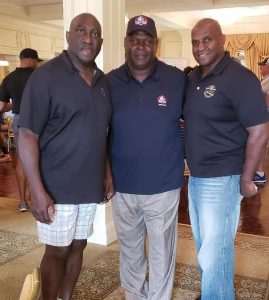
The Main Event from the 1981 draft Hugh Green, Ricky Jackson and LD Azobra
LD:
Taylor Singletary,
LD:
Ricky Jackson [inaudible]. Yeah. So matter of fact, I was drafted two rounds before no Rick was drafted. Then Mike Singletary, then me, it was all like right there, right. Close to each other. So I felt honored. Cause remember I was hurt and I got hurt the year Alabama game. So I didn’t know what was going to happen with my situation. But my, my coach, Bishop Harris and Kosovo, they, I suppose play the Japan, Japan in the Japan bowl and uh, senior bowl, senior bowl. So I had to forego both and I told him, I said, well, coach, I’m going to go to the Japan bowl. Ex-co Stovall honor. Is he, is he want to keep things upright? Well, if you’re not gonna play it on these gone, I’m thinking where I could still go drop myself. They said, we know you ain’t gonna play. Don’t go let somebody else go. Yes, but I wanted to go. Right. I’m not going. And I miss that opportunity. Uh, but uh, but I, I didn’t get, I didn’t work out for anybody because go Stovall and my position, coach, Bishop pears. So we know that the knee is not strong. Don’t you work out, but I was invited to some combine. So I got a chance to meet a lot of the player back then we went to combines every week. Yeah.
Greg:
You and I, you and I, we went to New York together. We went to Chicago.
LD:
Who was that guy in New York. We hung out with, I still can’t remember the guy. He brought it to his family house. We
LD:
Rented hall crackly for breakfast that morning. I can’t remember. But I
Greg:
Remember you and I had gone. That was my first day ever going to New York and you and I were together. Right.
LD:
And uh, well he was, that was Philadelphia. We was in Philadelphia. Uh, we flew into New York when we went to it. Okay. Because I remember it was cold. It was cold. It was really cold. But I went to Dallas was my first, see, I didn’t go to Dallas. They had everybody there at that one. So that was the best one. The best one, we went to quite a few comma. It was, it was just a great experience, a great opportunity for you to country boys to get out and baby, to see the other
Greg:
Part of it. And for the listening audience that we talking about combine, but back then each team did its own thing. So years later, all the teams got together and now they have a combined in one central place where all the teams come because we were doing that same thing you see on TV. Now we will do it now. Every week
LD:
We have week. Exactly. We,
LD:
It got, but not this, but it was a free trip. That’s right. They took good care of you. You got a chance to meet a lot of the players. Uh, those will be getting dropped. So you got, you gotta be your relationship with a lot of different guys. Matter of fact, it is date. I still talk to your teammate. Uh, EGA, EGA, Jr. We still talk. And Hugh green in that house and Ricky Jackson, we all still pretty close. And so, you know, because of that, that traveling get a chance to meet a lot of guys. That was a good, good opportunity. Missy, what other stores we got from the LSU LSU days? Cause we, the year we get drafted, it was quite a few of us, probably one of LSU, best draft ever.
Greg:
Well maybe later on they made a ha ha, but it went away. I’m talking about I’m talking before, before that it was one of the beds Dre for that, that was the best because we
LD:
Had, nobody went to first round. We thought Chris Wieden was going to go Christmas early second. So we had Chris in me in Tracy Porter. Didn’t you know,
Greg:
Chris was the first and the second you would a second in the second I went into third, Tracy went into fourth, hokey, went in the fifth, uh, uh, Ooh.
LD:
It was, it was quite a few who, well, a lot of guys get, get up, get got an opportunity. Right. And then the Jones twins,
Greg:
They got, they sign one sign with the jets
LD:
Coincide, uh, wireless, wireless.
Greg:
Yeah. Of with the Eagles. You wouldn’t be in it. Let’s see
LD:
Queens. And you had this equation. What was Queens? Uh, it was quite a few. I think Julia nannies hokey with fifth. Is it that you remember what you remember that at that time it was interesting to hope. It was like, oh, okay, what’s the last one to get drafted. But on the news that night, he was the only one they went interviewed. And that was interesting to me. I remember that, you know, the news, the TV didn’t interview any it didn’t do. Chris Williams was the first one to go. Then interview me. They went out, interviewed hokey. And that was always interested in how that process was going from bedroom.
LD:
You look at the bright side when he was always interested in how that at LSU though, it was all things always did work out. How do we, we did for, for real LSU, although it was not on my radar at all. I was muffled focus was my best friend. My cousin Ray Johnson was playing at nickel state. That’s all I knew I was hitting the NICAR state. LSU was nowhere on my radar. Uh, there was not a big at that time. It was not on TV that regular. So you know who was LSU. So, but I’m thankful that I had, they opened the doors, gave me the opportunity. Let me make the best of it. Because of that. What four and four, four or five years later, we able to sit here and have a conversation about
Greg:
Our journey.
LD:
It was a heck of a word to remember this young man. And I, we butt he every day. Our last two years of practice,
LD:
It’s hard to, they one-on-one every, they don’t even allow that drill anymore.
Greg:
No. Did all not Andrea. They don’t let you hit
Greg:
And pan that much now. And I don’t think they let you go. One-on-one like that anymore. I remember
LD:
When we, when was Nalco Scott got here. I mean, yukata, you know, you let Baca with first because you already know you had already been going against each other. And uh, Malcolm was always, you know, he stood up high. He didn’t know how to get it. No. So good blog to save his life. They gave you today. That’s because you can use able to block it. But we have a,
Greg:
I was able to block. I couldn’t hook you though. [inaudible] so
LD:
That was always pretty interested. But you had to, you was drafted by a Philadelphia,
LD:
Right? Third round.
LD:
I was drafted by Atlanta. Second round. You played the Philadelphia only what?
Greg:
Just that count. And again, things happen beyond our control. We had three T the Philadelphia Eagles had just gone to the super bowl and they brought me in and I was the third tight end. So we went through training camp and that’s a week before the first game. They give me a call, man, man, just everybody, everybody loves you. So I go see Dick for me. And he said, Greg, I’m so sorry. He said, listen, we having some problems with our offensive line. And if I put the lineman on injured reserve, he has to sit up for games, but he’s not hurting bad enough for me to put him on injured reserve. So I have to keep him on the roster, which means I can’t have three tight ends. And he said, we just went to the super bowl and I don’t want to have a veteran tied in and a rookie tied in on this team because we too good to have that big a drop-off.
Greg:
If the starting tight end gets hurt, you know, we, we have a chance to get back to the super bowl. And I don’t trust the rookie to start on this team right now. So we going to put you on waivers, but I don’t want you to leave Philadelphia because as soon as that offensive lineman gets well in two weeks, we’re going to adjust our roster again. And we’re going to bring you back. So stay in Philadelphia. Well, as soon as they released me and you know how that works, they put me on waivers and the minute they put me on waivers, the St. Louis Cardinals picked me up. So the time I left his office, I get a call from St. Louis that I need to go to St. Louis. So I had to fly to St. Louis that night or the next morning. And I played in that first game of the season and I made it all rookie that year. You not get all rookie, but all of those titles that they drafted with Scott and the guy from Tulane.
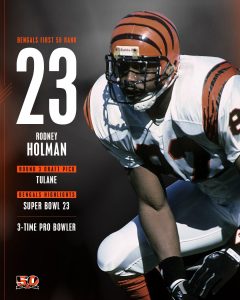
Tulane Tight End drafted in the 3rd round 1981
And I made all rookie that year. I don’t remember that. Yeah. That year got my bonus money. And everything was that the same year
LD:
That we, that you came to Atlanta that same year we
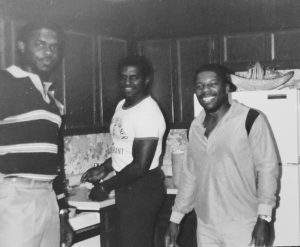
Lafleur in Atlanta the evening before we played the St Louis Cardinals 1981
Greg:
Came to Atlanta. I had to play against you. That was, that was pretty interesting. That was hard. Yeah. That was hard, man, because you will, we will write across each other. Matter of fact, I wouldn’t visit you the night
LD:
Before, the day you came by the house and the next day I had
Greg:
To play against you. And, you know, we both fighting to, you know, make the it’s the stay on the team. And I had to try to give all I had, and I had to train my mind, like, okay, forget this Lima. And just try
Greg:
To go and have to, you know, but it was hard. It was very
Greg:
Difficult for me to do that because, you know, I knew what play was coming. You didn’t know. And I had to do my best to get you out of the way, you know, to block. And, uh, but it was very difficult for me to do that. That was tough because somebody had to look bad either I was on the bed or you were going to look bad. So I had to train my mind to not think that was you at. So I would try not to look at you. You know, when I break the hum, I kept my, my eyes on the ground because I didn’t want to look at you. You know? But that was, that was tough. Yeah. I thought you was doing it just to throw me off. You didn’t want to want me to read, you just didn’t want to look at you in the eyes because you know, I could, I have to come at you full speed, you
LD:
Know? Yeah. Can we just meet, you got through hanging out then the night before.
Greg:
And I know a lot of guys that played with each other in college play against each other in the pros, but nobody goes against each other head
Greg:
To head. Like we, we, we had a lineup
Greg:
Head said the whole game. Yeah. And we both want to make it.
LD:
No, we was on the team. It’s the second game of the season.
Greg:
I can’t remember what game it was, but it was a regular season game and we have to bring it. And you guys meet us. We did. Yeah,
LD:
I dunno. Was that it was early in the season. It was very, very who’s running back at [inaudible]
Greg:
And y’all had William Andrews, I believe when you bedrooms. Yeah. Y’all was bringing it man. Andrews. He was chilling,
LD:
But he was strong. He was, he was a big strong guy just to bring back all the memories like, okay. But of course our history is really, we know we, we we’ve been connected for a long time. We still together. We, we fought for each other with each other. And to this day we still do. You know, if there’s a need or something going on, I can call you. You can call me. We started organizations together. We did, we had done a whole lot together and to have the relationship. And also more importantly, David, to sit here and talk about this, this, this, this is pretty darn good.
Greg:
I hope people enjoy it as much as I enjoy me. And so
LD:
I just appreciate, uh, Greg, uh, being here, sharing this moment, this time, uh, with, uh, with me, it truly, truly means a lot. I mean, that that’s, that’s for real, for real, you are the first brand that, you know, Mr. Granger, you know, those, these, these are these older, all of the people I love and have a level of respectful, but you and I, you know, we get a whole lot of history. We ain’t going to talk about in between. We had to come to work together to overcome or let me know. I’ll let you know, we had, we had a whole lot with the work too and work around. So they just don’t know what to say, but thank you for showing up once again and, uh, participated in sharing your story, your history, and, uh, and being honest about the things that happened back back then, and, uh, trusting that when you say you showed up today and there was some, some strange things that happened in the last 24 hours. So I don’t know what this is all about. You want to share who you go with it?
Greg:
Yeah. It was interesting yesterday. I had to take a ride to Appaloosas, which is 20 minutes. And I saw you had a show. Your show was about Edwin Edwards and it had 22 minutes. So I said, well, that’s a good time for me to listen to your show about Edwin Edwards, the former governor. And so I was listening to the show and you started, you mentioned my father in your presence, in your, uh, in your presentation. And as you mentioned, my father’s name, my phone rang my cell phone ring in the car. But for a second, I thought maybe that was a phone ringing on the, on the shelf because it just, and I saw it was Dale brown. I’m like they’re around. And when I answered the phone there, brown started telling me how much he enjoyed a magazine you wrote. And he said, and you automatic, you wrote an article about Greg the floor, and you have this beautiful picture of Greg LaFleur on this, on this magazine. And he said, uh, so as he kept talking, I’m like, I don’t think he’s talking. I don’t think he realized he’s not talking to me. I mean, that he’s talking to me as a coach. This is regular floor.
LD:
Oh, he’s said, I thought I was calling on what?
Greg:
And he said, look, I was just on, I’ll call you lamb LD. He called you lamb. And he said, I would just own lamb a show this week. And he brought me in, we spent about two and a half hours together. And he said, I really enjoyed him. He said, he’s very, uh, very intelligent. He said, I had no idea. He was so intelligent. And, and uh, the way he asked the questions, he made it very easy for me. He never interrupted me when I was talking. And I said, of course I don’t, I don’t mean to cut you off. But I said, I’m headed to Baton Rouge tomorrow to be on his show. And so we just started talking and we talked for a good 30 minutes on the phone, but I thought it was so weird how that happened, you know, for coach brown to just call me out of the blue. But he was not trying to call me. He was trying to call you,
LD:
He thinking about me, but we’re looking at your name. Yeah. I guess that’s how he accidentally called me. That was pretty interesting. And so he said,
Greg:
Look, if you come into Baton Rouge tomorrow, he said, I’m speaking at the sports academy. Come meet me at the sports academy tomorrow morning at nine o’clock. I said, I’ll be there. I’ll meet you at nine o’clock
LD:
At night. I was supposed to be the, how did they go? Oh, so
Greg:
You get what I’m talking about. That’d be good. Yeah. It was good. You know, they had all the kids and then he came in and a lot of the former players were there, basketball players. A lot of, a lot of the former players were there, college temple with his two sons and, uh, Rudy Mac, uh, Stanley Roberts, uh, how it caught her Nikita Wilson. Yeah. Most of the guys that played for him, they were there.
LD:
They, they coming out, he he’d stay in touch with his players. He does a wonderful job. I mean, water football. We don’t, we didn’t get many calls. I didn’t get in a call. So I didn’t get, no, I can’t say I got to say this about, uh, Charlie McLendon. Every time he came to town because willing to be done with a deal till the saying he was stopped by by restaurant. So he did while he was still around, still alive, he was stopped by. And just how and keep on
Greg:
Moving one last thing, uh, about coach McLendon and see, you can attest to what I’m about to say, because when the teal with the Vikings, when they would go down to tamper, coach Mac would always call any LSU player that would go to Tampa because he was living in Tampa. So if I can play it in Tampa, he called Willie, Chris Williams went to Tampa. He called Chris Williams. So Emin play. I talked to John Alexander when they would go down to Tampa, he would call y’all. So we played Tampa. So I’m waiting for my call. I never got
Greg:
A call to go back when I got the thing, [inaudible]
Greg:
Again, trying to figure out why he called me out at that team meeting. So I guess that had something to do with it, but he never called me. And we, we played Tampa almost every year within the league. And you never got a call, never heard the quarterback
LD:
Guess he did with him. And, uh, with a PV him, he coached PV, PV, PV, PV. They would stop by the restaurant just for a brief second. But you become a, and they go by their business. Yeah. I
Greg:
Would still like to know why I was on coach max, bad list or whatever, because I didn’t break any rules. My grades were always good
Greg:
To, I didn’t date his daughters,
LD:
Click, click, click this lake that we didn’t, we didn’t know what to think that
Greg:
Y’all had the right to assume something like that. He was hard on you. Well, you know, a lot of times players come up with excuses like, oh, the coach didn’t like me to coordinate. Mine was not an excuse because the whole team saw what was going on with me. You know? It’s not like I’m just making these things, but I would put co Stovall too. Yes. That’s pretty serious. Yeah. We couldn’t convince callback to put
LD:
You on a beat with Costo Stovall so that you was well able and capable of playing on the next level where, and I’m glad to say too. I was your team captain. So as your captain, uh, but they were, uh, thank you for showing up, like people participated. Thank you for the many years of a comradery, our, our relationship and all that comes with it and appreciate you. Thank you for showing up and participating in count time. Remember it’s 4:00 PM. Stand up is counted. Thank you, my brother for showing up and participate. Well, thank
Greg:
You, LD. And I will be listening to the, the rest of the shows from here on out.
LD:
All right. You’re going to be on several of them from here on out. Thank you.
What years did Greg LaFleur play at LSU? Greg LaFleur played wide receiver and Tight End for the Tigers from 1976 – 1980
What years did Greg LaFleur play in the NFL? Greg was drafted in 1981 in the 3rd round by the Philadelphia Eagles and played through the 1986 season playing for the St. Louis Rams and the Indianapolis Colts
Greg also appears on another episode of Count Time where he and LD review Billy Cannon A Long Long Run which includes discussion of the legendary Billy Cannon Halloween run.
Selected quotes and notes from Count Time Podcast with LD Azobra and Greg Lafleur discuss Billy Cannon Book
This is a review of Billy Cannon A Long Long Run
LD:
Good evening. Good evening. Good evening it’s 4:00 PM. Stand up. It’s count time, time for every man and woman to stand up and be counted. Welcome to another edition of count time podcast. I am brother LD Azobra formerly named Lyman White. Thank you for joining us today.
LD:
Today, I have a special guest, a special friend, uh, someone, we got a lot of history together. We’ve been talking, he been keeping up with the podcast and I really, really appreciate him, uh, tuning in on our podcasts on a regular basis. And we just want to have a, a great conversation now is going to be unusual because for real is the first time we could be doing this, but we’ve got a segment. We call the living legend segment, and this is going to be considered one hour. Live in legends. Yes, Greg is one of our living legends. We’ll be speaking about another living legend. So right now I want to introduce my dear friend and a teammate and we go back a long ways. And I thank you for being here, Mr. Greg Lafluer.
Greg:
Thank you for having me Lyman. I’m excited to see you.
LD:
Thank you for coming out here, Greg. I know you’ve been traveling all over the world every time I speak with you in another place, another country, and you, uh, I think you moved there. Where are you? Yeah,
Greg:
Well, I’m living in Seattle, Washington. Now. I’ve been blessed that I’ve been able to travel all over the world for the last couple of years. I’ve been to France, England, Germany, Italy, Colombia, Mexico, just Tokyo, Japan. Just the name of you.
LD:
Yes, yes. A few, a few major ones too. That I would be even more out of. When you say Africa next time. Of course, that’s
Greg:
Next on my list. Next spring, we plan to go to Spain and then Africa,
LD:
Africa, Morocco, that because that’s where the great Moors came from, who conquered Spain and rules banned for 700 years. I know you know about that history, right?
Greg:
Not as well as you do because you’ve been to Africa. That’s one reason I want to go is because when you came back from Africa, you were telling me how great the trip was. So when the opportunity presented itself, I thought about you. I’m like, well, Lama told me how great Africa was. I need to make that trip.
LD:
Well, I forgot we had a conversation about that back then. It did a lot. It, it took me somewhere that I didn’t even anticipate on being mentally and spiritually. It was a rude awakening. It was a great awakening. Also, maybe the frustrated irritated, because I felt I’d been lied to hoodwinked. Bamboozled I been had like great X said by the system they taught us is almost like in our podcast. We say for all so long, the system has taught you what to think. Count time here to teach you how to think. So trusting and believing that that’s what count time is doing. That’s what count time has been able to do. And today we’re going to have a special, uh, dialogue conversation. We’re going to be talking about it. Another one at LSU legends, Mr. Deli Canada, a few weeks ago. No, probably about a month ago. Uh, gray called me to tell me about one of the podcasts he had heard and what he thought about it. He was excited, elated Ellis regarding the cost and live long. What did you tell him? [inaudible]
Greg:
Oh, it was one of the best interviews I’ve ever heard at least sports interview ever heard because it was so in-depth and I don’t know how other people would receive that information, because if you did play sports, I don’t know how you’d hear it. But if you were a football player or anybody that was involved in sports, that was one of the most enlightening interview I’ve heard.
He touched me. You a good friend can call and tell you that, that that’s, that goes a long ways. Now truly, truly appreciate it. And I truly appreciate you being here. And because of that, he got excited. He started telling me about a book. He read it. Yes. Greg fluid. I do read the dub jacks. He was so excited and elated. He would just feel with John about this book. Uh, tell us a little bit about the book right quick. Well,
Greg:
You know, when I listened to your interview with coach Lynn and the blog, he started talking about certain things that I read in the book. And when I called you, I’m like, man, you really enjoyed this book because some of the stuff goes from the Blas in, in, uh, in your interview. I had already read it in the book, but the interesting thing was I was headed to Columbia global top Columbia, and I was in San Antonio and I needed to get a book because I can’t speak Spanish. So I needed a book to read while I’m in Columbia. So, you know, during my downtime, at least I’ll be reading because I can’t go and talk to anybody. So I was just looking for a book and I was in the bookstore browsing around and I saw this book with Billy Cannon’s picture on it.
Greg:
I’m like, well, if I’m gonna get a book, I will get the one about Billy Cannon. I’m not doing anything. So I just read that book. And then that book shook me up. I was because I can relate to everything that he talked about in that book, because I knew Billy Cannon LSU Great from 1972, he and, uh, Paul Hardy, the agriculture commissioner of agriculture, Gil Doscher flew to Ville Platte. And I picked, and, uh, Billy Cannon was with those two guys. And when I picked him up at the little airport outside of their plant and drove him to my parents’ house to meet with my father, my father said, do you know who that guy? And I’m like, no, I don’t know who he is. He said, well, that’s really cannon. Who’s Billy Cannon. He said, well, he won the Heisman trophy. So then I started paying attention to Billy Cannon and you know, he was at my parents’ house and I’m sitting there looking at this guy that was built so well. He had only been out of the league like three or four years. So, and a few years later I get recruited by LSU and now Billy Cannon and I have something in common. We both went to LSU. So that’s how my interest started in
LD:
Billy Cannon. It’s pretty interesting that he came to your house. He came
Greg:
To my house, they were campaigning for the 1972 election, the first election, Edwin Edwards one and Gill Dorsha and Paul Hartford was on that ticket back then you got to tell him who your dad, my father was Gervase from the floor and he was Edwin head was right-hand man, back in 1972, when he was running for governor for the first time
LD Azobra, Kevin Faulk LSU great Billy Cannon and Eric Hill
LD:
You got, you have a lot of history with this state is, uh, with LSU and your dad made a big, had a big impact on you coming to LSU and getting you involved with the community. So, I mean, we, he has a whole lot of history. We appreciate that. And I only know Billy by way of LSU ran it. One of the first golf tournaments. I was invited to the show with country club and I might’ve been, might’ve been me and one other brother there. And cause he lived in Sherwood forest at the time. That was my first time meeting him at a golf tournament probably in early, early eighties, like 81, possibly. So that was my first time meeting him and Jim Tilly both was a very respectful, just peer, very considered. They accommodated me. They knew I would kind of like out of, out of place in a lot of ways, but he was, they was very accommodating and very, very, a good guy.
LD:
So when Greg, he was so enthused and excited about the book, he said, he told me I need to read it. I’m thinking, man, I got some other stuff going on, tend to read a book right now. But he was so, uh, I asked him about it where I said, I’m gonna have to read this book. So I got the book started reading it. It is, it’s an awesome book. The book is titled Billy Canada, a long, long run look proud was written about four or five years ago, right before his transition when he passed on. And it’s a book covers a whole lot of his history. And even from Addie Nando, Billy Cannon was from Mississippi originally. So that was a great learning part right there. And sober you call
Greg:
It. I can’t remember his hometown, any
LD:
Soap, the show, Mississippi, Philadelphia, Mississippi. So he grew up in a small town and his mom, his dad dad’s name was harvest or Harvey and his mom name was Virgin. And it was a pretty good history. Let’s talk about, uh, what the [inaudible] matter of fact, we did, we got determined. This is going to be our first. So we talked, we discussing a book, I guess we know we got a great scholar, Greg Fluor. So people would be like electors. I don’t know what to call it sex. I guess we’ll call count time, booking, Clover, that booklet booking and clue. So I don’t know, but I appreciate you sending me a capita book. The book was really, really first-class it very engaging. They’re honest. You know, he bought for a lot of information.
Greg:
And what got me about the book lamin was that I’ve known Billy Cannon since 1972. And then when I came to LSU, you know, I got to know him even closer. And then when that incident happened with him, he kind of became a recluse. And so, and I always wondered why that hadn’t been a book written or a movie written, uh, made about Billy Cannon and come to find out. When I read the book, Billy Cannon didn’t want a book written by about him or move it down about him because he could have made a lot, a lot of money had he had a movie made by him about him, but that was not his thing. And he said in the book, the only reason that he let this writer write this book is because that guy worked at the penitentiary with him. He was a minister at the, at the, at Angola and he trusted the guy and he finally decided to, uh, do an interview with this guy and allowed him to write this book. And that was toward the end of his life because he didn’t walk people to totally know about him until toward the end. And that’s what I thought that was what was interesting when I first picked up the book,
LD:
When that movie came out years ago, when we was getting out of college,
Greg:
I can’t think of what he talks about it in the book. And he said they were trying to portray him, but that was not about him. They’ve tried to make a movie about him, but it didn’t.
LD:
That was not yeah. With the movie, but it did. But the movie we know was really dealing with, he was attempting to portray the cannon, but it was not the true story. They didn’t know, really have a story
Greg:
That slipped my mind, the name of that movie. Cause we all remember when they were filming that movie here in Baton Rouge,
LD:
Because I was like, I’ll look at the movie a few months back. Right. And, and I did not know coach SAM, Nader was in the booth that was interested, needs to see ghost data at a pretty beat over the Kevin comic. They call it Cammy. Gabriel appears right now in a culture culture in the movement. But it was a, it wasn’t a no that as we well know it, cause a lot of guys went out to, they asked former athletes to come out, talk, try out for the movie. Right. And a lot of players went out and I saw some of the guys in the movie. Yeah. So it was pretty good. But I put the deliver where we built the Canon plate. It wouldn’t do any of us playing at the time. So they would, that would made it kind of hard to, but, but deli in his book and in, in life too, he was very, he respected all people, you know, at the time he did see me.
LD:
Matter of fact, one of last time I really spent the time talking with him was when Nick Saban was in town, when Nick’s day would run, it won the national championship. I had a bunch of footballs I would to get side because saber signed the books when the ball was. And when I came out of the, uh, the facility with the bowels, the Canon was coming across the street. I said, Billy, so he’s, Hey, how you doing? We started talking, started engaging. So he said, uh, I say bad guys. We got all of them, all of them down bowls. I said, I just got upset and said he was offered some friends of mine who expert, uh, you know, one of the few national championship they had since yo D’s right. Yes. And I said, I wouldn’t get upset and say, I need for you to sign.
LD:
But two or three of them said, what my name would be. Why do you want my name on? I said, well, since you here, you don’t know the first, uh, national championship fee. I said, so it’s going to be, might have that much more value. I don’t know what happened to the balls or the way they are, but he did sign about, I had about eight and he signed about three of them for me. So that was the last time I seen him. But let’s talk what we want to start at there, but where the, what part that really captured you. And, and I
Greg:
Hope everybody go out and buy this book because you really enjoy it. Particularly if you’re an LSU fan or a person that grew up in Louisiana, it’s not just an LSU book. It’s a really a Louisiana book, but what stood out the most was that, and more, and I don’t want to say too much about books because I want people to read it, but I want to talk about this because this is knowledge that you can find anywhere else. The thing about Billy Cannon that I had heard about that when I first came to Baton Rouge in 76 to go to LSU, Billy Cannon is the first athlete to lift weights. Most people don’t realize that, uh, weight lifting was taboo for sports. Back in the day, people thought weight lifting would make you slow and muscle down that type of stuff. Well, there was a gentleman named Alvin Roy who was from the stroma high school and he was in the military. And because he traveled all over the world like Russia, Germany, and the Russians and the Germans were always beating the U S and powerlifting, would he learn what they were doing in Europe? And he brought that same method back to Baton Rouge. So he went back to his high school, Istrouma high school and he went to talk to the head football coach and ask him, could he let him work out for the football team? Well, that was such a taboo to lift weights, to play football. The coach like, ah, I don’t know about that.
LD:
Who’s who’s the coach, uh, fuzzy brown coach. That’s correct.
Greg:
And, and uh, so he said, well, look, I’ll let you work with the tractor. So he first worked with the track team and Billy Cannon was on the track team and did the Canon speed increase so much that it convinced the football coach. Okay, I’ll let you work with the football team. Well, Billy Cannon is the only person I know of my entire life that won the a hundred yard dash and the shot put in the state track, meet those two competition. Just don’t add up, you know, either you’re a sprint or a jump or a field guy with the wind, the shot put and the hundred yard dash and 200 in the state meet. So that proved that weightlifting increased your speed, your size and your, uh, and your quickness. So not only did he win the state track, meet his high school team, won the state championship in football, his junior year.
Greg:
And then they won the state championship again, his senior year and would have it that Paul diesel came to recruit, uh, Villa Canada come to LSU. Well, Alvin Roy convinced Paul [inaudible] and Paul Leeson was against it, but he convinced Paul Dietzel to lift weight. Well, LSU was the first college football team in the nation to lift weight. They won the national championship in 1959. And then, uh, Billy Cannon not only won the Heisman trophy. He was the first player picked in the draft. And I didn’t know that. I didn’t know if he was drunk. First player picked in the draft. Now he didn’t go to the NFL because the year he got drafted in the NFL, they started the NFL. And then Billy Cannon went to the Houston olives and he stayed with the olives. Then he went to the Raiders.
LD:
Yeah. The first time with the Rams. It matter of fact that the book said that he signed this contract after the sugar bowl game, right on the field, on
Greg:
The field. And then the, all us got him out of that contract. And you know,
LD:
And at that time I think the contract was worth 30,000 a year. And that was like a multimillion dollar contract back in those days. Yeah.
Greg:
And the other thing that was interesting about the book is that while he was playing professional football, he went to medical school in the off season. And now, you know how hard it is just to play a sport. I can’t imagine going to medical schools during the off season and to prepare to play in the national football league at the same time. I’m like, I was amazed to read all this
LD:
In, in the learn that, that Billy, when he moved from Mississippi, they had a farm. Uh, his dad had a farm, they lost the farm, moved to Memphis, moved to Tennant, Memphis, Tennessee. They moved to another part of Tennessee looking for work in standard R uh, during the time of the, of world war one, I believe a world war II, world war one standard are in Baton Rouge, but nice. Which now we call Exxon was hard. Cause they was producing a lot of our robo or whatever they need for the military. So that was a lot of money. It’d be in the bedroom area. So he said the family moved here for that to get some work. And Billy that’s when he began to, yeah, he got in a lot of trouble, even back then, he talked about the trouble that he got into. He was called himself a little, they call him a third so far for word third was popular. And he said it was, it was called him a third back then. Yeah.
Greg:
And that’s the part I would like for people to read because I had no idea he failed in the eighth grade. And then when he repeated the eighth grade, the second time he made all A’s. And as you know, he never had trouble with school after he flopped the first time in the eighth grade and everybody realized he was a great student, as well.
LD:
Matter of fact, he was really, he was, he wasn’t a big guy at all. You know, he went into his junior, senior weight, put on a lot of weight. He weighed at, I think 1 25, 1 50, right. Most, uh, you know, uh, first year too and high school, but he had great speeds. It, his speed was there when he put on that when they haven’t Roy came about and Roy was here when we first got to LSU.
Greg:
Yeah. Albemarle was around the Baton Rouge area when we got to LSU, but he was the speed coach for the Dallas Cabos strength, conditioning coach for the Cowboys around that time. But Alvin RA built the first gym in the United States. So you see those anytime Fitness’s planted, all those gems, the first gym was built in Baton Rouge in 1955. And it was on Oklahoma street right across where the old prince Murad was. If you went across the street on Oklahoma street, it was an old
Greg:
House to the left. It’s right off of Nickerson drive right
Greg:
Off of Nicholson drive. And, uh, the house was on the left and, and they, they turn it into a gym. And when I first got to LSU, my first time going to a weight room was at that Alvin Roy gym. And that was back in the summer of 1976. And then we started working out, uh, they made a weight room in the stadium. It was not very big.
LD:
So when you first got Delancey, there was no weight room
Greg:
In his head one, but they would still work out.
LD:
Yeah. I know when I got a lot of guys was still going to win. I forgot. I came the next year. It was still going, going. A lot of guys wanted to be, he wasn’t near as much anymore. Right. But a lot of guys wanted him to,
Greg:
Well, I didn’t realize it was still there when you cave.
LD:
Okay. Because it got a lot of, a lot of guy was going. I never went, I don’t remember ever going.
Greg:
The first time I got here, I went to the Alvin Roy gym before I even went to the LSU was wait room. So
LD:
Billy flop in the eighth grade repeated a angry, went back to school with a different attitude and decided he was going to do better for himself. And he excelled in academics. So he knew that he was capable of doing the work, not knowing that he was going to exhale to the level he did in sports. So he was a three sport guy, right? Basketball, football, and track and field. And he’d done exceptionally well at all three, but he said he was better in track then football then basketball. So that was pretty interesting to do that at Dillard, uh, you know, play. But there was one thing that happened to him that his dad, his dad got hurt, uh, working at Exxon Exxon standard or at the time he was, uh, he was the two man, I guess he did a lot of, um, I guess we call mechanical type of work now, you know, preparing, uh, working on different, uh, pipes or whatever it might be. And he slipped off the top of a scaffold, fell out, hurt himself and never really recovered. And there was a network was able to go back to work with the applicator’s leg, amputate his leg after almost a year, the opportunity is late. So he wasn’t able to go back to work. So he became the wife, Virgin had to go to work and he had to stay home and be a stay at home mom, which effected his two boys, Billy and Harvey Jr. Probably was what about three years? Four years old. And Dylan,
Greg:
Maybe two years
Greg:
Older than me. And he did well in sports too. Right.
Greg:
They won a state championship with his brother two
LD:
In a row. Yeah. His brother wants to have a role in football, football, and football. So, you know, all I was at the now what, the interesting thing about the story bill is that his dad told him that their genes came from athletic genes gave away. You remember that part helped me with, that came from when he lived in, uh, Mississippi, he said the great grandmother was married to an Indian. Yes. And he said, they came from the Indian side of the family. And that was pretty interesting when he talked about it,
Greg:
See, you remember this? You just read it because I read this a while back and you bringing all this back to me.
LD:
Yeah. That was that. Cause that was saying we’re holding on an Indian. So it would be, you know, they got a, you know, he got a combination of, uh, genes with him and I was in there. And also he talked about when Billy talked to, he made it a point to make a comment about his best friend when he was a real young boy was a little black boy in Mississippi that he hung with it. He grew up with, in a Tennessee that he had, he got to know, and that was it like when his close close friend. And it was just, you know, he made certain points of emphasis on certain things that he thought wasn’t that I guess he was important to him in his growth, his growth in, when he came to Louisiana based when he was saying that Mississippi was more integrated than
LD:
Louisiana. Right. So
Greg:
Because he never played with a black player, you know, neither in high school college. And once he got to professional football, that was the first time he ever had a black teammate. But when he was growing up around a stroma area, he always played with the black kids. You remember that part, you know, he played with the black kids. So it was, he had no prejudice in him. He, uh, he looked at people as they were, and he didn’t have any bias toward anyone. Right. You could tell when you met him, he was that with,
LD:
Yeah. He treated everybody. He was just straight up type of guy. And you know, then you start thinking about LSU. LSU was one of the last teams to do what LSU
Greg:
Was the last team in the nation to integrate its athletics. Uh,
LD:
Even old miss visit. The state had integrated
Greg:
The Southeastern conference. The conference that LSU belongs to was the last conference in the nation to integrate. And LSU was the last school in the conference. They integrate LSU was dead last when it came to integrate in as athletics, as a
LD:
Matter of fact, you and I were there. We had some tough times dealing with things at LSU. Cause we was, it wasn’t the first, but we were still close to it. We weren’t that far behind. And there was a lot of issues and concerns, but when it came to what they call black and white right back then, and we, uh, we’re not going to talk about a lot of that right now, but it was a lot of, a lot of different diff the sermon.
Greg:
You see the alarm alarming. The first black athlete to play at LSU was college temple in 1969. And it took two or three years later for LSU to have his first black football player. And that was Mike Williams and Laura Hinton. So that was 1972. And I got to LSU in 76. Mike Williams had just finished his last year. I didn’t get to play with Mike and lore
LD:
College got in 1970 or was it seven it’s. Okay. But you know, neither of us got, had a chance to play with the great Mike Weaver and Laura Hinton. Matter of fact, it’s just now I think this coming Monday, the, in the sea of LoRa Hinton can be on a hall of LSU hall of fame, uh, that they can be voting on this Monday at LSU to make him, uh, you know, why not? I mean, you know, he’s, he’s, he’s a outstanding man and the community hard worker and he did done his, done his part to deserve it. But, uh, Billy was very versatile in a lot of ways, you know, not just his personality, where he treat people, he had this, what they call a bad boy kind of attitude to that at, uh, like that John Wayne and Elvis Presley, [inaudible] he, he had a unique kind of person that he was, he wasn’t afraid, you know, stood for what he believed in. He took a chance, you know, he would, you know, I, I could not believe that he would just go out and Rob people. So he would do it, things like that at a young age,
Greg:
When people, when he was a junior in high school, he almost didn’t play his senior year in high school. Uh, they had to make an exception for him to play because he was in trouble. He got in trouble and find it, the courts dropped it or what? I can’t remember the details right now because I read the book, uh, a while back. But, uh, thank God that the, the justice system dropped it. And then he could go on and play his senior year.
Greg:
Right. Because Billy, after his dad, Harvey gotten hurt, there was no money coming in. That’s correct. And him and his brother also, he said, he worked at a man does meat market, which is still located right downtown now, nearly near the state Capitol. And he worked there as a young boy. He say packing and unpacking chicken and sausage. And in a whole half of a cow, he said, so he was, he was a hard working young man. But when his dad got hurt, there was, there was all traumatized by that. Cause his dad being the bread winner, the stable part of the family, your mom didn’t work at all. So after a while, he had to figure out how to, how to survive, how to keep money in his pockets when he was out there, dug it. And I guess in a convenient, different, you know, the people in the community, totally the doors don’t mess with it.
Greg:
Like, you know,
Greg:
Stay away from here. And, but because of everybody, the coaches, his teammates, the teachers, everybody liked him. He knew he was a smart, smart guy. He knew he was a good guy. So they really would do it all. He can, they help him to make sure that he succeeded. I mean, they all do bad with his day. But Billy also talked about, and this, I guess this is why I really liked the book too. He emphasized that at the stroma games that, although there was none, not one player after they sit on the team, they would allow them to go to come watch the games. There was a lot of them to go in the south part of the stadium to watch the game. But bill has told a story too, that came along with that, that really worked hustling cellular and pro programs at Memorial stadium when Kalin high played when Southern university played. Right. And he said that he used to watch the great old deposing. You remember that guy? Yeah. So was the poster was a running back for Southern university. He said he watched over the poses. School is out LJ. LJ was, and I moved through the holes and he made all these long run. He said, that’s what he wanted to be like, oh, the pool.
Greg:
Yeah. I was interested to me, but you know, he has, that was his idol only. Oh, the poses. Yeah. It always, the poser was, uh, one of the best running backs. And he was a tennis player at Southern and he played, I can’t remember who he played for, but he played in the NFL for a few years and he owned a gas station. The last time I saw old pools, it, it was quite awhile ago. He had a cup of beans in north Baton Rouge. So I don’t know if you remember.
Greg:
Well, I know of him, but I don’t. I’ve never met him. Well, he was in
Greg:
Bed. He lived in bedrooms for quite, quite some time. Had I believe he passed in bedroom because he had a gas station right there in north bedroom. But he also has another bit, I can’t remember what type of business it was because a friend of mine played my friends. My dad played with him and that’s how I had a chance to meet. And everybody was bragging on how grateful I read it back. I smoothed the runner. He was, and then they just talked about it, but they still rebuild a cat, a book. And he made quite a few reference about the great old deposing that’s who he wanted to be like.
Greg:
And I guess Billy, Kevin had a little something to do with the things we got involved with. We got to LSU and I thought it was interesting when he talked about how he’d sold his tickets in high school to make a little extra money. You know, he bought the tickets, you know, you’d inflate the price a little bit and he’d go out and sell those tickets. And, uh, people couldn’t believe he would buy so many tickets at one time because like, he won’t be able to sell those things, but he did and made money. Well, when he got to LSU, he did the same thing. And when we got to LSU, I didn’t know what that was originated from. But I think maybe that’s where that came from. When we got to LSU, I heard
Greg:
That Billy would buy a whole sections of LSU tickets or just whole sections. Cause that’s why he walked away because he figured if I buy the ticket,
Greg:
Cause he can sell his chicken in a different motivation. He was a businessman. He was a businessman
Greg:
Ways to make it, make it for himself and his family, which was pretty ingenious. And, and
Greg:
The ticket manager at LSU at the time, they couldn’t understand what he was doing when he bought all those tickets at one time, because it was a risk because if LSU would not sell it out, the first time they ever sold out was when you heard cultural law, talk it on your show. When they played together, they had that first sell out at the LSU at that time. So he bought all those tickets and they were able to sell out the stadium. So he made good on his, on the risks
Greg:
He did very well. And when we was there, uh, that was that we talked about it a little bit later, but we did sell out tickets. But also Billy talked about not just selling the tickets. I can remember the part came, bring it back and working to bring it back, memory field. We don’t want to bring it back, but you just want to tell the tickets another aspect of that, that he had figured out. But also he talked about in this way, I really connected with it. You remember the great eight? Pardon the airport. You know, he talked about airport in the book. My junior year, I worked for airport. You have a workforce.
Greg:
I never worked for him, but y’all got paid well paid. Well, and I always wanted to get off on the stuff. Lives, got to work as a team with ed fund. I had to do that. You know, hard labor job. Yeah. But no, you have to be, you have to be special to work with ed. Oh, I realize that not everybody got to work with him.
Greg:
I had a chance to work with it. Like you said, he looked out for us.
Greg:
He put me
Greg:
Partner queen. Uh, we went over there, the big cages and then he called me in to come. And he was [inaudible] at this hotel on, on airline highway came every day. But the hotel, it was the bell. The bell is further back down on the coming back south. It might’ve been what the bay about the hotel. It’s a small place right next to all star cars, car dealership. That’s what we used to go meet him all the time. Him and his partner, big deal. They call it a big deal. But I can’t remember his name. He was a guy like the bouncer. So he would act to meet us there if you have you sit to eat with it. But we didn’t realize until we did, we left years later that we really was a lot. All of us was a danger because people had threats out on this life. We didn’t even know that.
Greg:
Yeah. He was close friends with, huh?
Greg:
Jimmy Hoffa. He testified against off. So we need to blame LSU for putting us at home.
Greg:
Cause we didn’t know that all that was going on only the superstars. See, you didn’t even realize you were a superstar. I didn’t know that you got to work with ed part and the Teamsters. I worked at big Cajun too, but I was a laborer. I had to go to the local union place and your check to get assigned, to go work somewhere else. The star players got to work as Teamsters where y’all just got to ride a truck, just drive around in a truck. And we out there shoveling digging ditches. And so you could put pipes in the ground at big Cajun when they were, I worked with the pipe fitters, but I had to work with the ones digging the ditches. So they put the pipes
Greg:
In, but we had to come pick y’all up.
Greg:
So yeah, that’s what girl did go pick us up.
Greg:
So Billy said that he had been a dealer work with work for the teachers, right? [inaudible] he really, he looked out for each left out for us. He did it. He did a great job. I have never forgot, always think about airport. And he really looked out for us and I really appreciate it for that. So bill had that experience and he moved on from winning championships from trouble, young man, but from a great family, mother fault who really cared and respected and show him a lot of love. He, the one chose to go the other direction and he shares a lot of this in his book. And we do know that later on that Billy had gotten into some serious trouble and we know what all that, but that’s about what you want to share that right quick.
Greg:
Yeah, because I always wanted to know why would Billy Cannon do something like that? You know, because we knew he gambled, uh, he was a big horse fan. You know, he go to horse races and when that incident happened, people thought it was because he was betting on horses and lost all his money. And that’s what everybody thought for a long, long time. And I’m in. And so when they wrote the book, he got into details on what happened to him, which caused them to get into the trouble that he got into. And it was because the economy had fallen apart in the eighties, he had bought all types of real estate. And when, when the bottom fell out, he was in debt so bad. And that’s how he got, uh, involved with that kind of fit. That was a guy I don’t, I don’t want to say too much about it, but that was a guy in Baton Rouge who had already been arrested for counterfeit.
Greg:
And he knew that that, and the guy just made a comment to him and in joking and Billy Cannon thought about it and you’re like, well, maybe we should try that or something. And that’s how he got caught up in that counterfeit thing is because his is, uh, cause he had a very successful dental practice, but he was getting into real estate and the bottom fell out. And that’s why he got it, uh, got into that counterfeit thing to try to make money, to pay the debt that he owed on all the real estate that had fallen apart.
Greg:
But even as a young man, he was a pool hustler. He used to hang out at the pool hall. So he called himself like a pool shark or figuring out ways, make a hustles, even hustling most of his life. And you know, you and I both, you know, Billy got some serious trouble, but you and I have went through different things in our lives. Uh, like, you know, I had to do time too. So for Medicaid fraud, you went through some things that use the cues, uh, you know, say falsely accused of something that caused you embarrassment, heartache stress and in annual job. Right?
Greg:
So I guess we all, the three of us all have some income. We all said we can add on to what we have in common,
Greg:
Stupid, uh, whatever was it, uh, what, what his name is, uh, Tupac. I’m going to be the three most mornings, the three boats that you just, just to kind of highlight your situation that you went through quite a few years ago and you finally got vindication
Greg:
This year, right? Well, no, it was, it took a whole year before I could go to court. And then it’s very rare that somebody that that’s arrested for soliciting a prostitute goes to court and fight it in court because it’s, it’s a very low crime other than the publicity that you get. But I had no choice, but to go to court and defend myself because I didn’t do anything wrong. And, and luckily, uh, this undercover police officer that came up to me and started soliciting me, and this was on a Sunday afternoon, at six o’clock in downtown Houston, right by the Toyota center weather with the rockets,
Greg:
You, you was going to a championship game. What
Greg:
Was the final four for Houston for the final four? And they play on that Saturday and that Monday, and this was
Greg:
2011. So you talked about 10 years ago. Exactly.
Greg:
And, uh, so I’m, I’m, I interviewed tick price for the job at Southern and I, I was in my motor home at a camp, route 15 miles south of Houston. And after my interview with Tik price, uh, I said, well, you know what? I need to go get something to eat. And it’s a 15 mile drive to Houston. So I drove it to Houston downtown. It was a free concert or whatever. When the concert was over, I said, I’ve got to get me something to eat before I take that 15 mile drive back to the campground where there’s no place to eat. You know? So as I was walking, I stopped at the stoplight. Walking is about 6 30, 7 o’clock that afternoon. And some lady came from behind me and started soliciting me. And first thing I know police officers came out of nowhere, plain clothes police officer grabbed me in handcuffs and what we, the jail about three blocks. I was handcuffed walking down the street in Houston with three or four undercover cops on east side of me. And I’m walking down the street handcuffed, taking me to jail. And, uh, so I had to, once I was released three days later, uh, Southern university fired.
So it’s a use on lockdown for three days. You’re stuck, stuck.
Greg:
They wouldn’t let me out on about, they said I was a flight risk. I couldn’t believe it. I almost fell out. I had to see a judge with the video camera, you know, and, and he was in his office and I was standing there and he said, I’m going to deny your bail, your flight risk homo stated my knees buckled. I’m like, I live in Louisiana. Where can I go? And he said, well, look the university. Yeah, yeah. And he said, I was a flight risk. And then, uh, so they said, well look, let me see what I can do. He said, okay, Tuesday, I’ll assign it to, to be arraigned Tuesday in court or whatever on that Tuesday. So they not letting me out that Tuesday morning to go to court. And then, uh, you know, that process started. But when I had to defend myself lamin and that Josh Florida thing that came out just bought back a lot of memories or what happened to me because in the police report was totally different on what happened to Georgia, Florida.
Greg:
And thank God that young lady had that camera because the police report and the camera, what we saw in the video was not even close, but that was the same thing with me. That police officer report was nothing about nothing. Like what happened. Her store was totally different about what happened, but what saved me was she was wired and the conversation was on tape. So when we, when we went to court, all I had to do all my lawyers did was play the tape and I testified. And normally when you’re in court, uh, your lawyer don’t normally let his client testify. So they know we want you to go and testify and tell your side of the story. And all I did was going told my side of the story. The jury went in 34 minutes later, they came out, um, not guilty. So he had a jury, had a jury trial. It was a jury trial. Yes.
Greg:
And whenever reason a year later that went unchecked. Uh, notice nobody, no publicity, no like nobody I knew about it because you know, we all know each other, but very few people knew that you had been dedicated that you had it
Greg:
Didn’t have near the amount of publicity that I received when the incident happened. So a year later, when I’m vindicated, the mountain, Africa did a great job. They did a big story, but ESPN didn’t do anything. I even called ESPN. I’m like, Hey man, you guys need to say something about this because they blew me up when it happened. And they didn’t even mention, I was bending
Southern university had long let you go. Within the first months of university, first couple of weeks
Greg:
Ago, on my way back from Houston, they called me and told me I was fired. So you need to get back to work, make it back to campus. They called me as I was driving back to the bedroom and told me I was fired. No.
Greg:
So when we get into more of that,
Greg:
He put anyway, you can see what we have in common with bill. Again, I know we kind of went a direction here, but you can see,
Greg:
But that, that, you know, we all had a long, long run in some way with the law. I mean, it’s a long, long road, but it’s long run with the law. That’s how we got look at it. Yeah. But we all came out of it, unskilled and harming if able, if the city and talk about it. And, um, I’m excited that you’re able to sit here and share that book with me because the book was written by, uh, how you pronounce that name.
Greg:
John D D grew up Veles
Greg:
[inaudible]. So this is a great book. Uh, we know a lot of you, or might’ve wrote, written, read the book by an app. A lot of you have not. And, uh, and I’m sure that the canner family will love for you to a bad purchase. The book, read it. Their grandfather’s story is a great story. He’s a great man, a great human being. And we, I truly enjoyed it. I learned a lot and I really thank you. Great for sending me the book. There’s one other part I want to share about the book. It is, you see escape me right now that I’ve really enjoyed about the book, because it talks a lot about a lot of guys from Canada who end up all playing at LSU. They all are playing for one rap. Yeah. Well, the interesting thing, kitchen, they
Greg:
All played against each other in high school when he was at a streamer and Baton Rouge high was that biggest rivalry. And when he got to LSU, those stars from Baton Rouge high, uh, uh, [inaudible] uh, one route one route. I was the quarterback
Greg:
Cause kitchen. And they all played together at LSU and that would be such a great team. They, they always great high school star. They played against each other. They’re competitive also. So where at the end of the book, well, what about our coaches to the purpose? That purpose? I had no clue. Pete played with Billy. Yeah. He was the backup running back to the, again I had, no,
Greg:
I knew, I knew coach probably played running back, but I didn’t realize he was the backup to [inaudible] until I read the book
Greg:
Out of Mississippi. So I’ll be in coach purpose, coach LSU while we were there for three years. So we had a chance to get to know him. He was so he was a hard worker. He was a deep defensive back coach and he worked his guys hard. He got the both side. And you
Greg:
Know, when you had your interview with coach and then the bla, uh, cultural Oblon played off as a tackle. And I didn’t realize, I mean, I knew he played on that championship team cause he always rate. But when I heard your interview with coach of law, I didn’t realize he started the whole time. He was at LSU
LD:
That that would accept his senior year. He started senior year. He started Southwood junior year. Cause he couldn’t play as a freshman, sophomore, junior, senior year competition. He said, but uh, he, I mean he gave up his store was so great. I coached, he was my coach. And uh, you know, he, he really took care of me. So I can’t complain about that. Coach deployed. He just told me don’t get hooked. That’s what we did. So once again, we take, uh, my dear friend, uh, catheter, Mr. Greg Lafluer, uh, showing up today to do this interview and on the great Billy Cannon title of book, a long, long run. And we’re going to close the bus in it because all three, as we all had a long, long run with the law. So when we take it, Greg, thanks for being here and sharing your book, share this book would be the cattle with us.
Greg:
Thank you brother LD. I really enjoyed this time together.
LD Azobra describes the similarities between the U.S. Judiciary and the banking system. This is one of a series of topics set to decode the American system. LD asks the question is the judiciary a court of justice or a court of equity. Is the court a bank? What do you think? If you haven’t yet, subscribe to the Count Time Weekly Alerts.
Selected quotes and notes from Count Time Podcast with LD Azobra on the Judicial System
Good evening. Good evening. Good evening it’s 4:00 PM. Stand up it’s count time, time for every man and woman to stand up and be counted. Welcome to another edition of Count Time podcast. I am brother LD Azobra formerly named Lyman white. Thank you for joining us today.
The question is, is the court a bank? Yes. You heard me correctly. Living our everyday life, doing what we do on a daily basis. And in between that sometimes we get a ticket to go to court or something happens as we live in our daily life. And this subject matter is going to help all of us. I believe they don’t give us something to think about.
The question is, is the court a bank? How are you going to cross over from one to the other? How the court will be a bank or how the bank can be a court. That’s why Count Time is here, to enlighten, to engage you and to awaken those who are civilly dead.
And we know that we go to the courthouse. We always see these long lines. So you sit and stand in line to pay off Fine. So is that the same as going to the bank and the bank? Tell us there and you making a deposit or making a withdrawal. But at least at the bank, you can make a withdraw. But at the courts, you just simply paying off what they call your debts or charges or fines fees.
These people, also who collect money, are called bank clerks. But at the court system, we just call them court clerks, and their job is to keep ruckus, make sure everything is in order, make sure all five and fees and debts have been paid. So if there’s a difference between a Bank teller and a clerk, they all do the same thing. But we know the bank, at least you can make withdrawals. But the court, you only make deposits and they keep all deposits. They don’t send you nothing. They only sit there to collect.
Which one is true is the court a bank? We’ve been taught that the court is just simply a governmental body consisting of one or more judges who sit to adjudicate, disputes and administer justice. A question of law for the court to decide. Now, we’ve been taught that a bank is an officially Chartered institution empowered to receive deposits, make loans and provide check ins and saving account services all at a profit. So the bank purpose is to make money. We all know that.
So what’s the purpose of the court then? And how do you connect the two together? Now, many of us know that the bank charges you for fees. That’s what we call bank fees. So we know that the bank can charge you. But also, do you ever think when the courts charge you for a crime? So when you heard me right, you spell it the same way C-H-A-R-G-E charge. And the word is defined the same don’t matter how you look at it. So I want you to go back and pull the word up and look at his legal term. The word charge we hear in the course that John caught a charge or John have a drug charge. So what do the word charge mean?
These are things that we’re going to be talking about to enlighten you, to awaken the mind where you no longer can be deceived or tricked by this system. Because we’ve been hearing the word charge used in court system for a long time. We just never thought much of it. But the word charge, whether you had a bank or in the courts, has the exact same meaning. What do I mean by that?
Just like you open up a bank account, right? What is the bank account is simply a contract between the customer and the banker, whereby the bank obligates itself to honor a check or deposit. But also that, you know, in the court system, you have a court account. What do I mean by a court account where the court can charge you on several counts? Count one, count two, count three, et cetera, et cetera. So the court set up an account for you. You didn’t realize it. It’s the same word.
The coming start of the 2021 Olympics reminds LD of the pyramids and phoenix from the 2012 Olympic ceremonies. If you haven’t yet subscribe to the Count Time weekly alerts.
Any thoughts about England using ancient African symbols for display at the 2012 Olympics? Let us know what you think by commenting below.
Selected quotes and notes from Count Time Podcast with LD Azobra
Good evening. Good evening. Good evening it’s 4:00 PM. Stand up. It’s count time, time for every man and woman to stand up and be counted. Welcome to another edition of count time podcast. I am brother LD Azobra formerly named Lyman White. Thank you for joining us today. (listen to why I changed my name, it’s not what your thinking)
Today. I want this discuss a matter or issue that has been concerning to me for quite some time. Something that transpired quite a few years ago went unnoticed and unchecked, but as the lord would have it, time has come around again. And this subject matter might not mean much to many, but I just want to bring it forward. Maybe you have some discussions and dialogues and conversation about yes. What did happen? Why did that happen? How did that happen? And what am I talking about? Well, we know tomorrow is the start of the 2021 Olympics, which was cancelled in 2020 because of the Corona virus. What we now call COVID-19 where we know that the summer Olympics is always during the even years, like 10, no, 8, 12, 16, 20, I guess the same as all presidential race, I guess it just coincidental. Right. And I don’t know, but it’s just always doing those times of year just to be they missed last year.
So 2020 Olympics will be played in 2021 in Tokyo. Japan would be hosting the 20, 21 Olympics that starts tomorrow, July the 23rd. But what I want to bring forward is July of 2012 at the Olympics that transpired in London. So what happened that we won’t bring forward the 2012 Olympics from what I mean? That was, oh, I’m sorry. That was nine years ago. Well, something that I noticed and I was questioning to myself like, okay, how did this come in about where we know the Olympics, every country that hosts the Olympics, what they normally do is highlight spotlight, their greatest moments in their country. They had the history, they had development, what brought them to where they are, their greatness, their evolution that transpired in their country. And that’s the way everybody does it, right? To showcase their country where people can come in tour, people can come and be a part of their, their history come.
People can come and share because they want everybody to come and be able to spend money in their country. Where in the 2012 Olympics that took place in London, England, that was a few unusual things that I thought was happening. And I couldn’t figure that out. Like, okay, well, how did this come about? How do they do that? How did they do this? Where we know the first part of the Olympics is what they call an open end of the Olympics, where Queen herself showed up with James Bond. He jumped out of the helicopter with a parachute, which we know she didn’t actually do that. But symbolically, symbolically, you know, they had her like she was jumping out like she still is the Queen she’s in great shape. She’s still in position to rule and power to rule. But throughout the opening ceremony, they show the Europe as they came out of the, they didn’t really show the ice age, but we know that’s how it came about, it came out of the ice age.
And from there, they moved into many countries all over the world. And they showed that when he came out of the ground from under, under the tree and it showed them moving out continuously the men, they didn’t show that they didn’t show any women coming out of the, out of the ground with the show. Oh man. And it’s had men of different ethnicities coming out, which I thought that was kind of interesting, you know, some was of African descent and I guess, uh, some other origins origins, but it was pretty interested in to see that because I didn’t figure out, I couldn’t figure out how many of people of African descent came out of, out of the origin of the European culture. So that was unusual. I know that what they was just playing that they’ll multicultural, which is a new term, not in that they work with everybody, but anyway, they came out of the ground.
And, uh, I guess that ground also record represented a cave of the Europeans have been known to come out of a cave. That’s what a term cave may come from or what I was taught and what we was taught back in the days of school, but also with the ships and learned to navigate through the waters. They begin to travel all over the world and it took over many places, you know, to go with many other countries that they still rule to this day. And they were showing that they went abroad and, you know, they took their culture, took their, uh, their expertise, which we know they will businessman with the top hats on. And one guy had the book so that, you know, the deer rule, they control the knowledge and now let could be true, but we’d also know that a lot of knowledge would take her from other places that they utilize to their benefit.
And that’s what we all do. Right? We take knowledge from others and use it for our benefit, but fast forward. So as the people coming up, the men are coming out of the ground. I will say, coming out the cave of Europe, moving into other places, other countries, traveling the world, they begin to, they created the industrialized society that we all know to this day. Although the Africa was the first install, smite and iron, but it uses the use of iron thousands of years ago, but the Europeans did take it to another level. They started building a lot of different factories and trains and everything by using iron metal and made it where they can, you know, from the horse and buggy to cars, to airplanes, to where we, now we can, they talking about traveling to the moon and traveling tomorrow as a traveling space where I’m getting to is that yes, the opening ceremony was that they had shown showing their industrialized society, how they move from one place to another phone or one evolution to another transforming the world, transforming themselves.
And all that was great, but there was a part of the Olympics that was kind of, it wasn’t subtle, but it would just sit in there that I could not figure out how the Britain Angland claim this. If anybody can remember, I guess you can pull it up. You can just, you know, pull up the 2012 Olympics and the opening ceremony and the closing ceremony. As you look to watch ceremony at the top of the stadium, they had pyramids. I can’t remember how many, if I was a guest, they hadn’t had one in the front and had one in the back. So you’re talking about 30 pyramids or more of design that was on top of the stadium. Or maybe I would say 24 to 30, 30. There had to be more than 24. I would say at least close to 26 to 30 pyramids on top of the stadium.
Well, to me, even back then in 2012, I was wondering, and I was like, how, how and why do Britain have pyramids on top of the stadium? The pyramid is not part of the European culture. It’s not part of European history. Matter of fact, I don’t think there’s one pyramid in Europe. I have heard that several years ago, they found pyramid that they stay up here made in Bosnia when the European countries, but one of the first and few, besides the one they built quite a few years ago, a glass pyramid that was built that they use in front that was put in front of a mule, their museum, that when you, before you walk in the museum, you walked through the pyramid because also in the European museum, they got all the African history, right? If you want to study Africa, you got to go to Europe because they got all the history that it took it all from Africa.
The Louvre
It brought to Europe because the African history is so, so vast it’s phenomena. It goes back so far, all the things they’ve done, the development with all it created. I mean, it’s endless when you think about it, but how and why did Britain put pyramids on top of their stadium? That’s been a question I’ve been having in my mind. It just so happened. The 2020 Olympics is now being held in Tokyo in 2021. And us just started the podcast several months ago. So we have a chance to have this dialogue on the pyramids in Europe, which I don’t think they ever had that dialogue yet because there aren’t any, from the knowledge or understanding that I was taught or that I know of. So why did Britain put the peer? Me is on top of their stadium. What are they saying? What are they claiming our Britain now, or London, England claiming that they ought to create a, of the pyramid, which the pyramid represent high knowledge.
It’s a pass as any other knowledge because in organizations for the masons, the Scottish rights, the different organization, they all used to peer me. And we shared this once before the pyramid is so powerful, they put it on back a dollar bill. So that’s how powerful the peer mediator. But the pyramid is the history of the ancient people of Africa, not just north Africa. It’s quite a few places in Africa. We do know that Mali, Morocco, Ethiopia, Sudan, and ancient Kemet, which we now call Egypt, where all appear. And you can find plenty of also in other countries, you can go to Mexico, go chase the Nia, find pyramid. You can go to so many different places and find pyramids. You can go right here to the United States and find pyramids. Matter of fact, I attended LSU. They had two pyramids. They have two pyramids to this day on LSU campus that they claimed that some of the oldest pyramids in the world.
So to this day, they’re pyramids all over the world, except Europe. Why was that high as that? Why would they have no period pyramid built in Europe of food for thought, but your claim, the pyramid in the 2012 Olympics. So as we, I saw this happening, as I saw this unfolded, I would just add, I asked like stunned, like, why are these pyramids or pyramid structures sitting on top of the would call it Olympic stadium that was built to the 2012 Olympic in Europe. I still don’t have an answer. I’m just want to have a conversation. I need some help to understand how and why did this come about? But not just death. Let’s fast forward to the closing. 2012 Olympics. Another phenomena transpire as the limping was coming to a close, they started this, they had a fire that was part of the closing, which represents the torch and the Olympic fire.
They got to keep burning. So then also there was a, I thought was an African group, which they are, but they are without a Brazil. Their Europeans invited some Brazilians people to participate in the 2012 Olympic for the closing of the Olympics and the way he was dressed. I mean, you know, an African people, Brazilian people, the cultures best deal veer, very similar, you know, in Brazil, still to this day is the second largest that the second largest nation of African people is right there in Brazil. So they had them to come during the closing of the Olympics. I get to represent the Africans. And what happened at this time as the torch has been lit and the torches rising and opening, it went, it was open like a flower. Then it started closing. But also when it lit the torch, yes. What rose up the Phoenix bird, anybody know anything about the Phoenix bird is the bird that we say that rises out of his ashes are rises from the ashes, or was this important?
Once again is not a part of the European history. This was not taken out of the European history. It has nothing to do with the European history. I know the Greeks claimed it once they learned about it from the ancient people, but we all know the Phoenix bird came out of the great continent of Africa, Northern Africa, and others who worshiped and honored the Phoenix bird every 500 years. The Phoenix bird has been known to rise from his ashes to his elegance, his greatness out of the fire. And guess what happened in Europe, in August, 2012 as the burden of the torch, the closing of the ceremony, the Phoenix bird, the great ancient people, the great African people bird that they, we don’t know if it was a real Burr or symbolic men. And do not know to this day, it had been taught to say that every 500 years his rises out of his ashes to his greatness to show that you can’t kill him, can’t kill it.
We arise at his time. So I know your might’ve been in, we arising out of our ashes at this time, but it’s not their history. So why would they use a symbol that is not part of the history of culture? I doubt up to Japan. If Japanese or Japanese, we use a symbol. That’s not part of their culture. A doubt of the JIP Japanese would use a similar that is known for the European are known. Footer for India are known for some other country of India, of a China though. They gonna use symbolism. Everything they’d probably use to represent them in their culture, in their history. They would not use any of the symbols that has nothing to do with their culture, their history. So why did Europe chose to do that? They don’t have a great enough history to be able to use, to bring forward where we know that’s where all the violence took place in Europe.
Podcast History Africa
They’ve been known for all the great war warriors and creating wars, the general rules and the different, you know, people that came out of Europe over the years. But very few, besides the ones they call the great philosophers, Aristotle played tool, you know, so many more in the Aristotle’s and the Plato. If you go read their history, they’ll tell you, they went to the ancient cities of Africa, of Kemet to learn what they learned. They was not tarted in Europe. And we know when the, when, when the so-called Alexander the great, uh, the interesting thing about that, uh, you know, all my life I was taught. Alexander was the great when I went to Egypt first time, my only time and 1990. So over 30 years ago, I went to Egypt. It was the first time I ever heard. They called him Alexander the barbarian.
So that’s when you start learning, everything’s a matter of perspective on the side of the war I came from, they call him the great on the other side of the world, where he went and stole, did damage to the people, to their culture. They called him a barbarian, but the name of city after him in the great country of Kimmy, who we did the now called Egypt to this day. But we also know in that great city of Alexander, they had the worlds. It was the world first library. So I’m telling you, the library had must have been now four or five, 6,000 years old. The oldest library in the world was in north Africa who knew, who would have thought about, but when Greeks, the Greeks got there, they say they burned the library. I guess they did. After they sit and copied plays, awry, took all the knowledge, wrote it, rewrote it, and took credit for it in saying that the great Greeks are now became your great philosopher with the ancient people, call himself the great Sage, you know, cause they had to be, you know, they call it, they also call themselves, uh, what we call it.
Burning of the Alexandria Library
They call ministers today, but it had people like the great IMHO tip the first physician, the first doctor out of ancient Egypt, Kimmy M hotel, and the Europeans call him. I got to get this name, right? Eckler I can’t say the word. I don’t want to get it wrong. But to this day they still pay homage to him because him old tip was the father of medicine. But to be a great Sage as him hotel, great doctor, the gratefulness, very grateful, the great Sage Sage and a philosopher or similar, but a Sage, you had to be proficient in science, math, chemistry, law, everything. So you have to understand how all these things work together, how they all are one. So sort of great men and women of Egypt. They had to go to school for 40 years to learn this just they, they was proficient in all of these things in order to become a great Sage.
So they was able to map the universe, the possession of the star, the rotation of the moon, the sun. And to this day, we know we still worship these things, but let’s get back to what I was saying about that. So at the 2012 Olympics, when Europeans displayed the pyramids and the Phoenix bird rising out of his ashes, were they claiming that African people history, what it taken at the birthright of the ancient African people by claiming that this is their rightful history culture. Oh, they do have a showcase. Nick, could they really like him? And if they really liked what he meant, where those who don’t know, you probably would have thought, well, that must be part of their culture. That’s part of their history. Well, I’m here to let you know, none of it was part of their culture or part of their history.
So why would they even showcase that? Why would they even close out with debt? And even to have these pyramids on top of their, uh, Olympic stadium, that whenever he looked at the stadium, you saw these pyramids. So pyramid pyramid represent far knowledge and power. That’s how, that’s the power of a pyramid. We say, well, now, you know, pyramid is okay, where to this day we know how powerful a pyramid it is, what you mean by to this day where almost every church I know has a steeper on the top of it. When you pass by a church, you see a steeper and steeper represent a place, a worship place, a power, a place where the Lord dwells a place where energy fire take place. Cause the steeper is nothing but a pyramid. It does that same shape of a pyramid. So it represents power due to mass fire.
So that’s what we’ve been taught. That guac gut, that’s what we’ve been taught. It’s where God dwells. So to this day, a church has a steeple, which is only a representation of a pyramid. Now you can make it, you can call it whatever you want to call it. But it’s only a pyramid that triangular shape that came out of ancient Africa. So to this day and the days to come, we know that we still use the pyramid to represent a lot of things, but why would the Europeans claim the pyramids and the Phoenix bird to say that they’re rising out of that? Their ashes, not a UX, meaning Europe is the country that burned down other countries. So other countries theorized now the ashes and the damage that Europe cost to them. You know? So I’m just having a conversation with myself that I wanted to share with you and help that hopefully that you can help me to come to some understanding and hit us up, go to our, uh, website and leave a comment.
And let’s have some conversation dialogue on why did Europe use the pyramid and a Phoenix bird at their greatest moment that they could have displayed the greatness of Europe, but they displayed the greatness of Africa, the pyramid and the Phoenix bird, not the greatness of Europe. So why did they choose that? Why was that important? So important for them to utilize those symbols? Because we know the power and importance of symbols. So anybody see the pyramid today do they think of Europe? when you, when you see the Phoenix bird, do you think of Europe? No, I wouldn’t think so maybe the younger people, they, they were branding themselves. So they might’ve been rebranding themselves, right? To be the cradle of knowledge. And we know that’s not true, please we know that’s not true. So please help me by hitting us up and let us know what you think about Europe using the ancient African symbols to display at the 2012 Olympics.
Are you a terrorist? You might want to listen to this episode before you answer that question. LD Azobra describes how he learned about OFAC and what happened to him. This episode delves into the Department of Treasury, Office of Foreign Assets Control (OFAC) Sanctions Lists. OFAC publishes lists of individuals and companies owned or controlled by, or acting for or on behalf of, targeted countries. Are these lists ever used as a vendetta against US citizens? If you haven’t yet, subscribe to the Count Time Weekly Alerts.
Selected quotes and notes from Count Time Podcast with LD Azobra
The Office of Foreign Assets Control of the US Department of the Treasury administers and enforces economic and trade sanctions based on US foreign policy and national security goals against targeted foreign countries and regimes, terrorists, international narcotics traffickers, those engaged in activities related to the proliferation of weapons of mass destruction, and other threats to the national security, foreign policy or economy of the United States.
Living Legend segment features LD Azobra interviewing Southern University Football Hall of Famer Charlie Granger, one of the Deacons for Defense and Justice. Coach Granger discusses Louisiana history that he helped make. Hear his journey from Lake Charles LA, the tragedy of Hurricane Audrey, redemption at Southern University all the way to the Dallas Cowboys and much more. Part 2. If you haven’t yet, subscribe to the Count Time Weekly Alerts.
Selected quotes and notes from Count Time Podcast with LD Azobra Interview of Living Legend Charlie Granger Pt2
Won City Council. Served two terms and ran for Mayor twice, but also
You was part of the Deacon of Defense
Deacons for Defense and Justice that came out of Bogalusa West Baton Rouge Parish, chairman of the organization we were chartered under the Bogalusa tribe.
LD So you work with A Z Young
CG Yeah, right. A Z Young was part of that group. There was some soldiers that came home from military people, military people that did not like the way that they were treated in Bogalusa and wanted to do something about it legally. So they decided to organize the Deacons for defense and Justice.
LD And y’all had bylaws and we had bylaws and what have you
CG Yes. We had strong black men that was not interested in nothing but human rights and bettering their community. Yeah.
LD So you’re always concerned about human rights?
CG Civil rights didn’t even exist at the time. Civil rights was there. I’m the one that bring the human rights in. Okay. Yeah. That’s my thing. Those are my words the human rights Human rights would cover everyone.
LD Human rights is bigger than civil rights?
CG Human rights is bigger than civil rights because when we fought for rights, everybody rode in on our rights that we fought, everybody became civil righters But they were human righters Nobody know that. We’ve carried more people to freedom on the black movement. Even now, when we fight, we had to fight for everybody. Our civil rights has covered women. And now the homosexuals, everybody rode in on the blood and flags that we carry for civil rights. A lot of people look down on us as colored, but nobody looked at as the real Super. We’re Super civil rights fighters. We got so many other races on our back riding.
This Living Legend segment features LD Azobra interviewing Southern University Football Hall of Famer great Charlie Granger, one of the Deacons for Defense and Justice. Hear his journey from Lake Charles La, the tragedy of Hurricane Audrey, redemption at HBCU Southern University all the way to the Dallas Cowboys and much more. A human rights activist, advocate and elected official he tells stories of Louisiana history. Part I of 2 Part II discusses social justice history. Don’t miss the inside sports stories in the integration of LSU football, interview of Lynn Leblanc and an outstanding book review. If you haven’t yet, subscribe to the Count Time Weekly Alerts. #CountTimePodcast
Selected quotes and notes from Count Time Podcast with LD Azobra Interview of Living Legend Charlie Granger
LD:
Good evening. Good evening. Good evening it’s 4:00 PM. Stand up it’s count time, time for every man and woman to stand up and be counted. Welcome to another edition of Count Time podcast. I am brother LD Azobra formerly named Lyman White. Thank you for joining us today.
LD Won City Council. Served two terms and ran for Mayor twice, but also You was part of the Deacon of Defense
CG Deacons for Defense and Justice that came out of Bogalusa. West Baton Rouge Parish, chairman of the organization we were chartered under the Bogalusa tribe.
LD So you work with A Z Young
CG Yeah, right. A Z Young was part of that group. There was some soldiers that came home from military people, military people that did not like the way that they were treated in Bogalusa and wanted to do something about it legally. So they decided to organize the Deacons for defense and Justice.
LD And y’all had bylaws and we had bylaws and what have you
CG Yes. We had strong black men that was not interested in nothing but human rights and bettering their community. Yeah.
LD So you’re always concerned about human rights.
CG Civil rights didn’t even exist at the time. Civil rights was there. I’m the one that bring the human rights in. Okay. Yeah. That’s my thing. Those are my words the human rights Human rights would cover everyone. Human rights is bigger than civil rights.
Human rights is bigger than civil rights because when we fought for rights, everybody rode in on our rights that we fought, everybody became civil righters. But they were human righters Nobody know that. We’ve carried more people to freedom on the black movement. Even now, when we fight, we had to fight for everybody. Our civil rights has covered women. And now the homosexuals, everybody rode in on the blood and flags that we carry for civil rights. A lot of people look down on us as colored, but nobody looked at as the real Super. We’re Super civil rights fighters We got so many other races on our back riding.
In this episode of Count Time LD Azobra interviews Coach Lynn Leblanc and talks about coaching, the historic events he has watched and participated in, and why he was the Black recruiter.
“Interview done Saturday May 1, 2021 at his home in Baton Rouge Louisiana. Coach wife Lynette was also present for the interview plus the interview almost didn’t happen. Because when I arrived to their home coach asked had i been vaccinated for Covid19 and I said no. He stated his wife a retired nurse might not let me in the house. They were gracious enough to let me in an allow the interview to happen. It was a major concern because Coach who is now 82 and will be 83 this week.” LD Azobra
Selected quotes and notes from Count Time Podcast with LD Azobra Interview of Living Legend Coach Lynn Leblanc
Coach But I was a sophomore in high school. Okay, they had three guys, me, Danny Underwood, who came as a freshman, 6-4 240, didn’t have the feet. I was 6-2 89 90 when I came as a freshman. And Lee Reed, who came the next year, three players at Crowley. I was sophomore and Danny was sophomore. High school. Somebody in town paid our way to New Orleans to see the Sugar Bowl. And we caught the train in Crowley at 12 o’clock at night. Boy I remember I had a brand new pair of shoes on. Just killed me. had to walk around.
We got the New Orleans. We didn’t know what to do, where to go. We’re going to find our way to stadium. Um, but there’s a Penny arcade. You put a little nickel in there and you see these girls dancing and stuff. Thought we were in the big city coming from Crowley. Anyway, that was in 1954. You can look it up. Sugar Bowl.
Remember that? You go looking. Pittsburgh was playing Georgia Tech. Pittsburgh had a black running back, and I wish I could remember his name. In fact, I had an article about him not very long ago, but he was the first black to play on a white football field in Louisiana. And I saw that game in 1954.
And I don’t even remember who won the game. But he played with Pittsburgh. They allowed their people to come and to play, and it was 1954. But look, I think I don’t remember the first baseball game hell LSU won the SEC. And were picked to play in the tournament against blacks, and the state legislature voted against it. It wouldn’t let them play. You know, how ridiculous was that? I mean, people were stupid back then.
LD What year was that?
Coach I want to say this was like in 61, 1960 or 61. I think I might have been a graduate assistant on the football team. I coached two years on the freshman team. But anyway, the team won SEC and they were going to play in a tournament, you know, the first tournament and the state legislature voted against it and they wouldn’t let them go. Ain’t that ridiculous.
Coach Leblanc played on the LSU National Championship team. He talks about the Billy Cannon Halloween run, the “Chinese Bandits” and lessons on coaching and how to treat student athletes.
LD’s first Count Time interview is of Pastor Dennis Blackwell. Listen as they discuss:
Black and white school attendance during integration from different perspectives
Exploration of the impact of not seeing people of color as human on both the oppressor and the oppressed.
Commentary on the George Floyd murder.
Dennis Blackwell is a graduate of LSU and a Army veteran that spent 10 months in combat during the Vietnam war. He worked for Mortorla for 30 years while a bivocational pastor in Grand Isle, LA for 35 years. He is now retired from both but continues to serve the Lord assisting Pastor Adraine and Apostle Albert White at Abounding Love Ministries. If you haven’t yet, subscribe to the Count Time Weekly Alerts.
Selected quotes and notes from Count Time Podcast with LD Azobra Interview of Pastor Dennis Blackwell
Good evening. Good evening. Good evening it’s 4:00 PM. Stand up it’s count time, time for every man and woman to stand up and be counted. Welcome to another edition of Count Time podcast. I am brother LD Azobra formerly named Lyman white. Thank you for joining us today.
Selected quotes and notes from Count Time Podcast with LD Azobra Interview of Pastor Dennis Blackwell
Good evening. Good evening. Good evening it’s 4:00 PM. Stand up it’s count time, time for every man and woman to stand up and be counted. Welcome to another edition of Count Time podcast. I am brother LD Azobra formerly named Lyman white. Thank you for joining us today.
LD is Co-Founder and Director of Professional Athletes Supporting Students (PASS). If you haven’t yet, subscribe to the Count Time Weekly Alerts.
Selected quotes and notes from Count Time Podcast with LD Azobra
Good evening. Good evening. Good evening it’s 4:00 PM. Stand up it’s count time, time for every man and woman to stand up and be counted. Welcome to another edition of Count Time podcast. I am brother LD Azobra formerly named Lyman white. Thank you for joining us today.
This is a message to Darius Geis, young man I met years ago, who I have disconnected with up to this point in time. I’m doing this message in hopes of connecting back with Darius to encourage him to get help. And Darius was a young man, probably around 10 – 11 years old, maybe eleven years old. I got asked when I first met him. He and my son happened to play on the same football team called Jaguars. And we all knew then that Darius was something special. He really was. He was a fine young man, hard working. He outworked everybody on the field. He didn’t quit plenty energy, life, a lot of life in him, just very engaging, a lot of fun.
And one day I was talking with him, And I want to find out, did he ever visit LSU? Has anybody from LSU ever contacted him? But he was really young. So I figured nobody had contacted him. But I just want to make sure of that. Now, when I was talking with him, so as we was talking and I’m asking him, Has he ever visited LSU? He told me no, and I thought about it. I said, Well, I’m going to go talk to the coach.
The coach at that time was Coach Q. And I had a conversation with Coach Q about possibly bringing the players, the whole football team to visit LSU. And Coach Q was excited by they thought it was a great idea, and we lined up something and we decided we were going to bring them over there. So I contacted Verge and Coach Sam Nader, and they invited us over and we brought the boys over there one day and the boys had a great time. They had an awesome time. To be honest with you.
They got a chance to visit the LSU football facility, the indoor facility, which had just been built a few years before. I would guess so. They were all impressed with that. It was a great time. We all had a wonderful time at LSU. And thanks to Verge and coach Sam Nader for that, from there, things exploded for him. A lot of great things started happening for him. So I like to be one of the ones that encourage you there is to find help that way that if you find help, you can find yourself. And that’s the most important thing in life being able to find yourself.
Many have been affected, hurt and harm because of your actions and inactions. So now it’s time that we all learned that you got to accept responsibilities for your actions. That’s just the way you got to go. You got to accept responsibilities where you can move forward and others can move forward because people are willing to forgive. Now, it’s hard to forget. Sometimes we understand that. But people willing to forgive once you accept responsibilities, and we all come to that place in life where we got to accept responsibilities. I believe a lot of people that are hurting because of your actions, but also, I believe you are hurting as well. So I’m reaching out to you in hopes of that. You understand that we are here to help. I am here to help. And we quickly learned this life that we got to accept responsibilities for our action. And I personally know what you’re going through. I remember when you was a sophomore junior at Catholic High School, you came by my office one day to talk to me.